
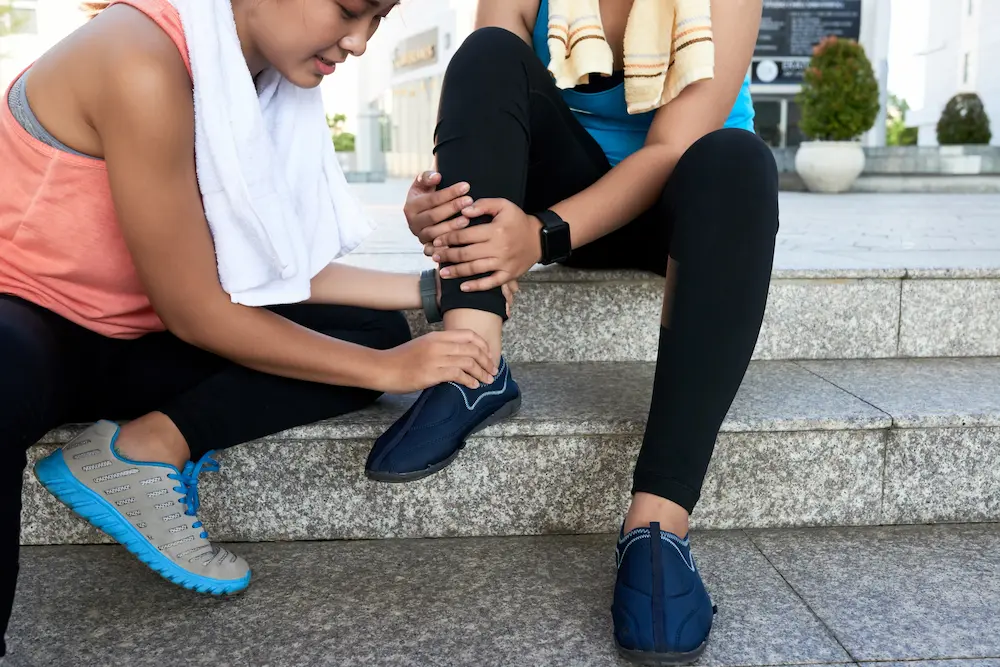
Custom orthotics are one of the most underestimated tools in knee pain treatment – and one of the most logical. Every step you take transmits force upward from the foot through the ankle, into the knee, and beyond. When foot mechanics are off, that transmitted force is abnormal, and the knee absorbs the consequences thousands of times per day. At Marin Joint Health in Novato, custom Foot Levelers orthotics are a dedicated component of our 12-week knee pain relief protocol because correcting the foundation is often essential to lasting results.
The Connection Between Your Feet and Your Knees
The foot is the body’s point of contact with the ground. It’s responsible for absorbing impact, adapting to uneven surfaces, and transmitting force upward through the kinetic chain with each step. When the foot does this job well, the forces that reach the knee are balanced and within the joint’s tolerance. When foot mechanics are poor, those forces become uneven, excessive, or misdirected.
The most common mechanical problem is overpronation – the inward rolling of the arch with each step. When the arch collapses, the lower leg rotates inward as well. That rotation twists the tibia, and because the tibia forms the lower half of the knee joint, the knee is pulled inward with it. This inward force – called a valgus stress – compresses the medial compartment of the knee, strains the medial ligaments, and shifts the kneecap off its tracking groove.
High arches create the opposite problem. A rigid, high-arched foot doesn’t pronate enough, meaning it can’t absorb shock effectively. Impact forces that should be partially dissipated at the foot travel up through the ankle and into the knee at higher intensity. Over time, this increases compressive loading across the entire joint surface.
Leg length discrepancy – even subtle differences of a few millimeters – creates asymmetrical loading between the two knees. The shorter leg’s knee typically carries disproportionate stress, which can drive degeneration on that side while the other knee remains relatively unaffected.
Why Over-the-Counter Insoles Aren’t Enough
Pharmacy insoles provide cushioning and minor arch support. For mild discomfort from standing on hard floors, they can be helpful. But for correcting the specific biomechanical problems that contribute to knee pain, they fall significantly short.
Generic insoles are designed for an average foot. They don’t account for your individual arch height, the degree of your pronation, your gait pattern, or any asymmetry between your left and right foot. Placing a generic support under a foot with specific structural issues often provides incomplete correction – and sometimes shifts forces in ways that create new problems at the ankle or hip.
Custom orthotics are fabricated from a precise analysis of your individual foot structure and gait. The correction built into them reflects what your specific foot needs, not what an average foot needs.
What Makes Foot Levelers Different
Foot Levelers is the specific brand used at our Novato clinic. It’s worth explaining why, because not all custom orthotics are made the same way.
Most custom orthotics support only one of the three arches of the foot – the medial longitudinal arch on the inside. Foot Levelers are designed to support all three arches simultaneously: the medial longitudinal arch, the lateral longitudinal arch on the outside, and the metatarsal (transverse) arch across the ball of the foot. Supporting all three provides a more complete and balanced platform under the entire foot structure.
The fabrication process begins with a detailed scan of the foot, capturing the exact contours of both feet individually. This scan is used to produce orthotics that are specific to your foot’s structure – not a mold of an average foot that’s been adjusted slightly.
Foot Levelers orthotics are also designed for durability. Unlike generic insoles that compress and lose effectiveness within months, properly made custom orthotics maintain their corrective properties for years with appropriate care.
What Custom Orthotics Do for the Knee Specifically
For patients with knee pain, the primary benefit of custom orthotics is reducing the abnormal mechanical forces that reach the knee with every step. The specific effects depend on the nature of the foot problem being corrected:
Reducing Medial Knee Stress
For overpronators, controlling the inward roll of the arch reduces the tibial rotation that drives valgus stress at the knee. This directly reduces compressive force on the medial compartment – the most commonly damaged area in knee osteoarthritis – and reduces strain on the medial collateral ligament and medial meniscus.
Improving Kneecap Tracking
Patellofemoral pain – pain behind or around the kneecap – is often driven in part by foot pronation pulling the tibia inward and shifting the kneecap’s tracking groove. Correcting foot mechanics from below can meaningfully improve kneecap tracking and reduce the grinding that produces anterior knee pain with stairs, squatting, and prolonged sitting.
Distributing Impact More Evenly
Orthotics that improve shock absorption at the foot reduce peak impact forces transmitted to the knee. This matters particularly during walking, where each footfall sends a brief spike of force up through the chain. Reducing the magnitude of those spikes reduces the cumulative load the knee absorbs over thousands of steps per day.
Correcting Leg Length Asymmetry
When leg length discrepancy is contributing to asymmetrical knee loading, a lift built into one orthotic can equalize the load distribution between the two knees. This is a precise intervention – the lift height is determined by assessment, not estimated – and it can make a meaningful difference for patients whose knee pain is predominantly one-sided.
How Orthotics Fit Into the Full Protocol
Custom orthotics are powerful for what they do – correcting the mechanical foundation. But they don’t address inflammation, decompress the joint, repair damaged tissue, or restore neuromuscular coordination. That’s why they’re one component of a comprehensive protocol rather than a standalone treatment.
At Marin Joint Health, the orthotics work alongside chiropractic adjustments that correct alignment from the foot up through the hip and spine, laser therapy and shockwave that address tissue repair and inflammation, and Trigenics that restores neuromuscular control throughout the kinetic chain. The orthotics ensure that with each step taken during and after treatment, the knee is receiving balanced, appropriate forces rather than the abnormal loads that contributed to the problem in the first place.
Think of it this way: you can reduce inflammation and improve joint mechanics through in-clinic treatment, but if every step you take continues to drive abnormal forces into the knee, recovery is constantly working against the biomechanical reality of your daily movement. Custom orthotics close that gap.
Who Benefits Most
Most knee pain patients benefit from custom orthotics to some degree, but the benefit is most pronounced in patients who show clear foot mechanics problems on assessment – overpronation, high arches, or significant asymmetry between sides. Patients with medial compartment knee pain, patellofemoral syndrome, and IT band syndrome in particular tend to show strong responses to orthotic correction.
Dr. Sarah Scharf includes a gait and foot assessment in every new patient evaluation at our Novato clinic. If foot mechanics are contributing to the knee problem – and in the majority of cases they are at least partially involved – orthotics are incorporated into the treatment plan accordingly.
A Note on Insurance
Custom orthotics are included as part of the 12-week protocol at Marin Joint Health. For patients considering orthotics independently, coverage varies by plan. Flexible payment plans are available for our full treatment programs.
If you’re in Novato or anywhere in Marin County and want to understand whether foot mechanics are contributing to your knee pain, we’d be glad to assess it. Call (415) 818-0243 or schedule a consultation online.