Treatment
Class 4 Laser Therapy
When tissue is inflamed and slow to heal, it needs a push. Class 4 laser therapy uses focused light to calm pain and speed recovery deep in the joint.
Class 4 laser therapy delivers concentrated, therapeutic light into injured tissue. It is a non-invasive way to reduce inflammation and support healing at the cellular level. It is one of the core technologies in our restorative protocols.
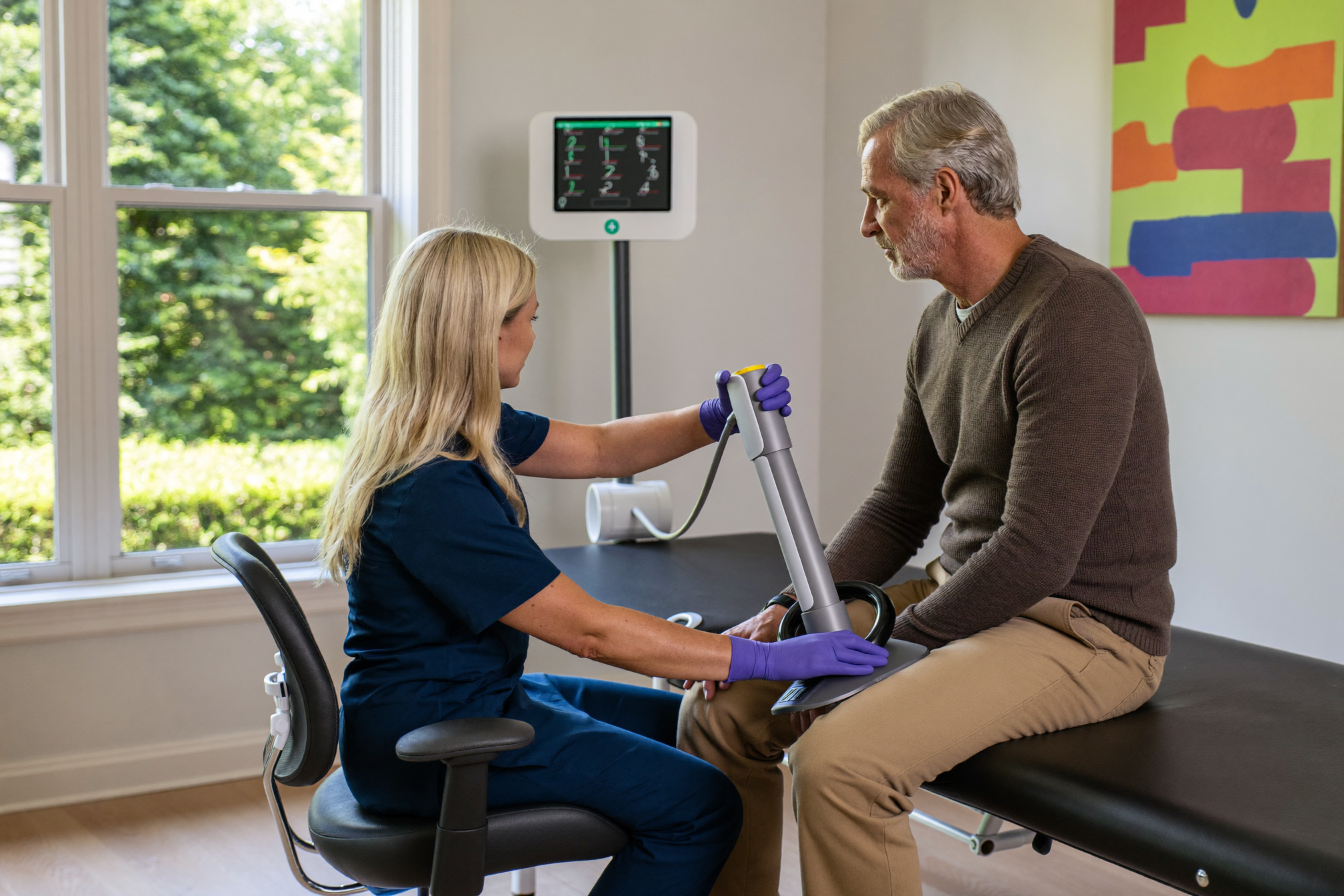
A handpiece moves over the treatment area, sending energy into the tissue below the skin. That energy boosts circulation and helps cells repair faster. You feel a gentle warmth, nothing sharp, and there is no recovery time afterward.
Inflammation is often what keeps a knee painful and stuck. By calming it and encouraging repair, laser therapy eases pain and supports the tissue-healing side of your plan. Dr. Sarah Scharf uses it alongside movement work so the whole knee improves, not just the symptoms.
Powering the cells that do the healing
Every repair your body makes is work, and work takes energy. The cells that rebuild an inflamed knee or a strained tendon run on a molecule called ATP, produced by tiny structures inside each cell called mitochondria — the cell's power plants. When tissue is injured, inflamed, and poorly supplied with circulation, those power plants slow down. The cells that should be healing simply do not have the fuel to do it quickly.
That energy shortage is one reason a stubborn injury lingers. The tissue is not unwilling to heal; it is under-powered. Rest helps, but rest alone does nothing to raise the cellular energy that repair depends on.
Class IV laser therapy works by delivering energy the mitochondria can actually use. Through a process called photobiomodulation, specific wavelengths of light give your cells the boost they need — drug-free relief while the tissue does its own repair work.
How light becomes energy in the tissue
Photobiomodulation is not heat treatment in disguise. It is a specific interaction between certain wavelengths of light and a molecule inside your cells.
Wavelengths chosen to reach deep
Class IV lasers use higher power and wavelengths selected to penetrate past the skin into the deeper tissue where knee and joint problems live — depths a heat pack or surface device cannot reach.
Absorbed by the cell's power plant
That light is taken up by cytochrome c oxidase, an enzyme in the mitochondria. The effect is like clearing a bottleneck in the energy line, so the cell resumes producing ATP more efficiently.
More fuel, better conditions
With more energy available, cells repair faster, inflammation is modulated toward resolution, and local circulation improves — bringing in nutrients and carrying waste away.
Where — and when — we use it
Laser is versatile, quick, and comfortable, which makes it one of the workhorses of our restorative protocols.
Inflamed, slow-healing soft tissue
Irritated knees, tendons, and joints that stay painful because inflammation lingers are the natural targets. Calming that inflammation lets the rest of the tissue move forward.
A soothing, drug-free session
The handpiece moves over the area and you feel a gentle warmth, nothing sharp. There is no medication involved and no downtime afterward — you carry on with your day.
Alongside deeper interventions
Applied over a joint recovering from decompression or a tendon after shockwave, laser supports the cellular repair those therapies set in motion.
Where laser fits your protocol
Laser rarely works alone. It is the tissue-level support that helps the mechanical work of your plan take hold.
It buys relief while tissue rebuilds
By easing pain and inflammation drug-free, laser makes the healing window more comfortable — so you can keep moving and stay engaged in your recovery.
It amplifies the mechanical therapies
Decompression, shockwave, and Graston create the conditions for repair; laser feeds the cells doing that repair, so the pieces reinforce one another.
Built across a series
Relief tends to accumulate over several sessions rather than a single visit, as each treatment adds to the cellular momentum.

Give your cells the energy to heal
If inflammation keeps a joint painful and stuck, calming it at the cellular level may be the push your recovery needs. Let's see where laser fits your plan.
Ask whether laser belongs in your planFAQFrequently Asked Questions
It helps patients with inflamed, painful, or slow-healing soft tissue, and it pairs well with the rest of our knee and joint care.
Sessions are quick and comfortable. Most people feel a soothing warmth and nothing more.
Treatments take just minutes, and your plan will spell out how many you need based on your exam findings.
Laser supports healing, but it works best in combination with the other parts of your protocol rather than on its own.
There is no downtime at all. Relief tends to build across a series of sessions rather than after a single visit.
 Marin Joint Health
Lasting relief from knee and joint pain without surgery
If knee or joint pain is holding you back, our doctors treat the root cause, not just the symptoms, without surgery or drugs.