Treatment
Focused Shockwave Therapy
Stubborn, long-standing pain sometimes needs a wake-up call. Focused shockwave therapy jumpstarts healing in tissue that has stalled.
Focused shockwave therapy uses high-energy sound waves to stimulate repair in damaged or chronically irritated tissue. It is non-invasive and especially useful for pain that has lingered despite other approaches. It is a key tool in the way Dr. Sarah Scharf treats persistent knee and joint problems.
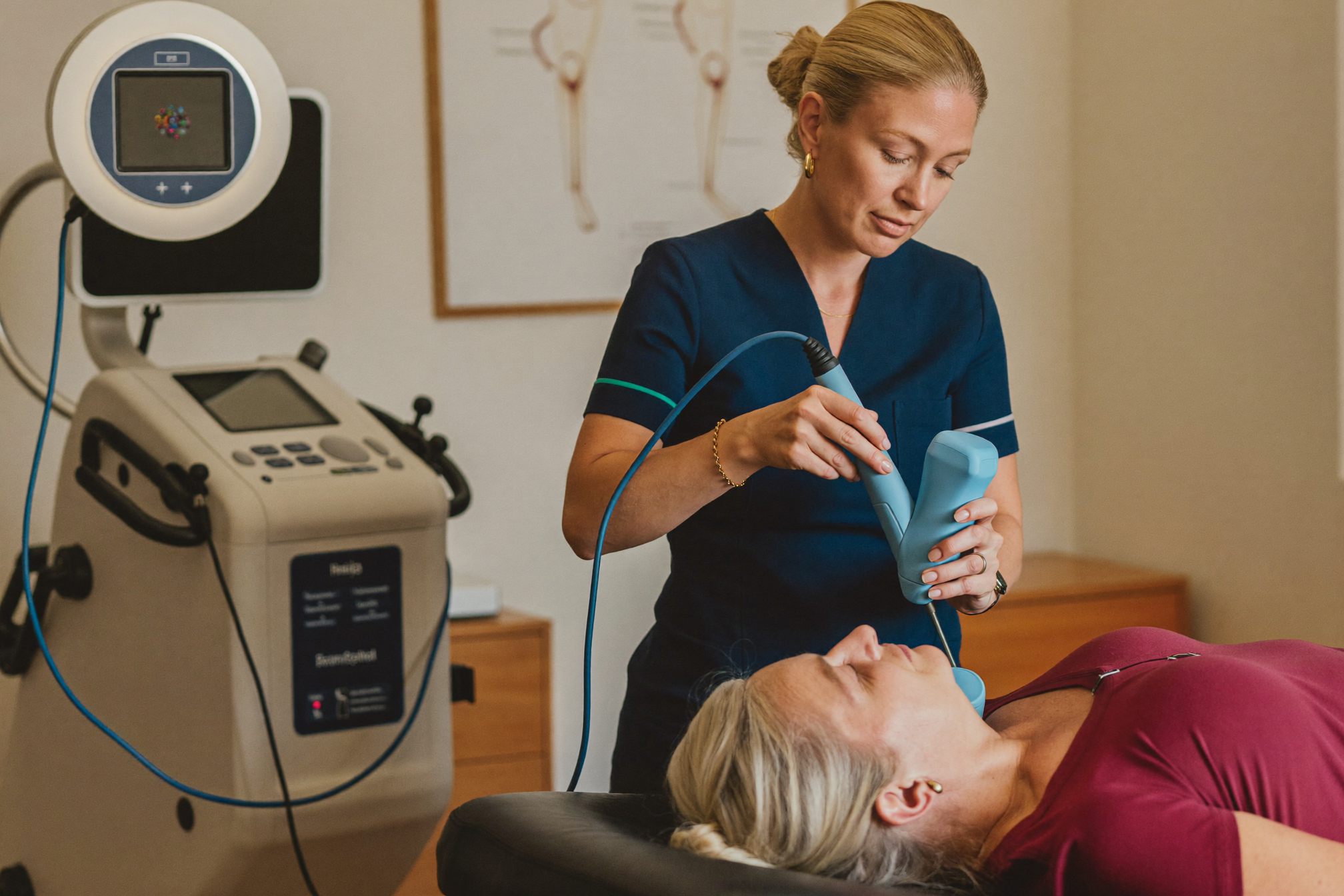
A handpiece delivers precise pulses of acoustic energy into the target area. Those pulses increase blood flow, trigger the body's repair response, and help break the cycle of chronic inflammation. You may feel a tapping sensation during treatment, which most patients tolerate easily.
Some tissue gets stuck in a low-grade injured state and stops healing on its own. Shockwave nudges that process back into motion, which can reduce pain and improve function where other methods stalled. Within the protocol, it targets the deeper, more stubborn sources of knee pain.
When healing simply stalls
A healthy injury follows a schedule. Inflammation flares, repair cells arrive, new tissue is built, and the pain fades over a few weeks. But some tendon and ligament problems never finish that schedule. The initial inflammation quiets down, yet the tissue underneath never fully rebuilds — it settles into a kind of limbo that clinicians call failed healing, or chronic tendinopathy.
This is the pain that outlasts every reasonable timeline: the Achilles that has ached for a year, the heel that greets you every morning, the deep ligament that never quite came back. Rest does not fix it, because rest is not what the tissue is missing. What it is missing is a signal — a biological instruction to start building again — and a stalled tendon has stopped generating one on its own.
Focused shockwave therapy is, at its core, a way to send that missing signal. It does not mask pain or force tissue to move; it prompts the body to restart the repair process it abandoned.
How sound waves restart biology
The mechanism is mechanotransduction — the body's ability to convert a physical force into a chemical response. Focused acoustic pulses are the force; a cascade of repair signals is the response.
Focused acoustic energy, aimed deep
Unlike scattered surface waves, focused shockwaves converge energy at a chosen depth. That lets the pulse reach a deep ligament or a tendon attachment precisely, rather than dissipating in the tissue above it.
Cells read the mechanical message
When those pulses reach the stalled tissue, the cells sense the mechanical stress and respond chemically — releasing growth factors and signaling molecules that summon the repair machinery back to the site.
New microcirculation follows
Part of that response is angiogenesis, the growth of tiny new blood vessels. Fresh microcirculation carries oxygen and nutrients into tissue that had become poorly supplied — a common reason healing stalled in the first place.
A controlled reset, not damage
The goal is to nudge dormant tissue back into an active repair state. The brief tapping you feel is that stimulus at work, and mild soreness for a day or two often signals the tissue is responding.
The problems it's built to reach
Shockwave earns its place with the stubborn, deep, chronic cases — the ones that have outlasted rest and simpler care.
Chronic tendinopathy
Achilles, patellar, and other long-suffering tendons that have been irritated for months are the signature use. These are exactly the tissues most prone to stalling in a failed-healing state.
Plantar fascia and heel pain
That sharp first-step-of-the-morning heel pain often comes from fascia stuck in chronic irritation. Focused energy can reach the attachment where the trouble concentrates.
Deep ligaments and attachments
Structures too deep for surface therapies to influence are where focused shockwave's aimed energy makes the difference.
Where shockwave fits your protocol
Shockwave is the therapy we reach for when tissue needs a jumpstart, and it works best surrounded by the right support.
For the cases that plateaued
When rest, stretching, and gentler care have taken you as far as they can, shockwave targets the deeper, more resistant source of the pain.
Sequenced with laser and movement
Once shockwave has triggered the repair response, Class IV laser can support the cellular work, and progressive loading gives the rebuilding tissue a direction to grow.
Measured over a series
Improvement usually builds gradually across several sessions as new tissue matures, which is why Dr. Scharf tracks your response and adjusts as you go.

Wake up tissue that stopped healing
If a tendon or ligament has been sore for months with no real progress, the problem may be a stalled repair signal — not something rest can fix. Let's assess whether shockwave can restart it.
See if shockwave can restart your repairFAQFrequently Asked Questions
It is well suited to patients with chronic tendon or soft-tissue pain that has not responded to rest or basic care.
You will feel a rapid tapping during the session. It is brief, and most people handle it well.
Sessions are short. The number in your plan depends on how your tissue responds, which Dr. Scharf tracks over time.
Mild soreness for a day or two afterward is normal and usually a sign the tissue is responding.
There is no real downtime. Improvement usually shows up gradually over a series of treatments.
 Marin Joint Health
Lasting relief from knee and joint pain without surgery
If knee or joint pain is holding you back, our doctors treat the root cause, not just the symptoms, without surgery or drugs.