Treatment
Back Pain
Back pain has a way of touching everything you do. We focus on the cause so you can bend, lift, and move through your day with less of it.
Back pain can stem from disc problems, joint restriction, muscle strain, or nerve compression. It ranges from a dull ache to sharp, limiting pain. Our approach is conservative and non-surgical, aimed at the underlying problem.
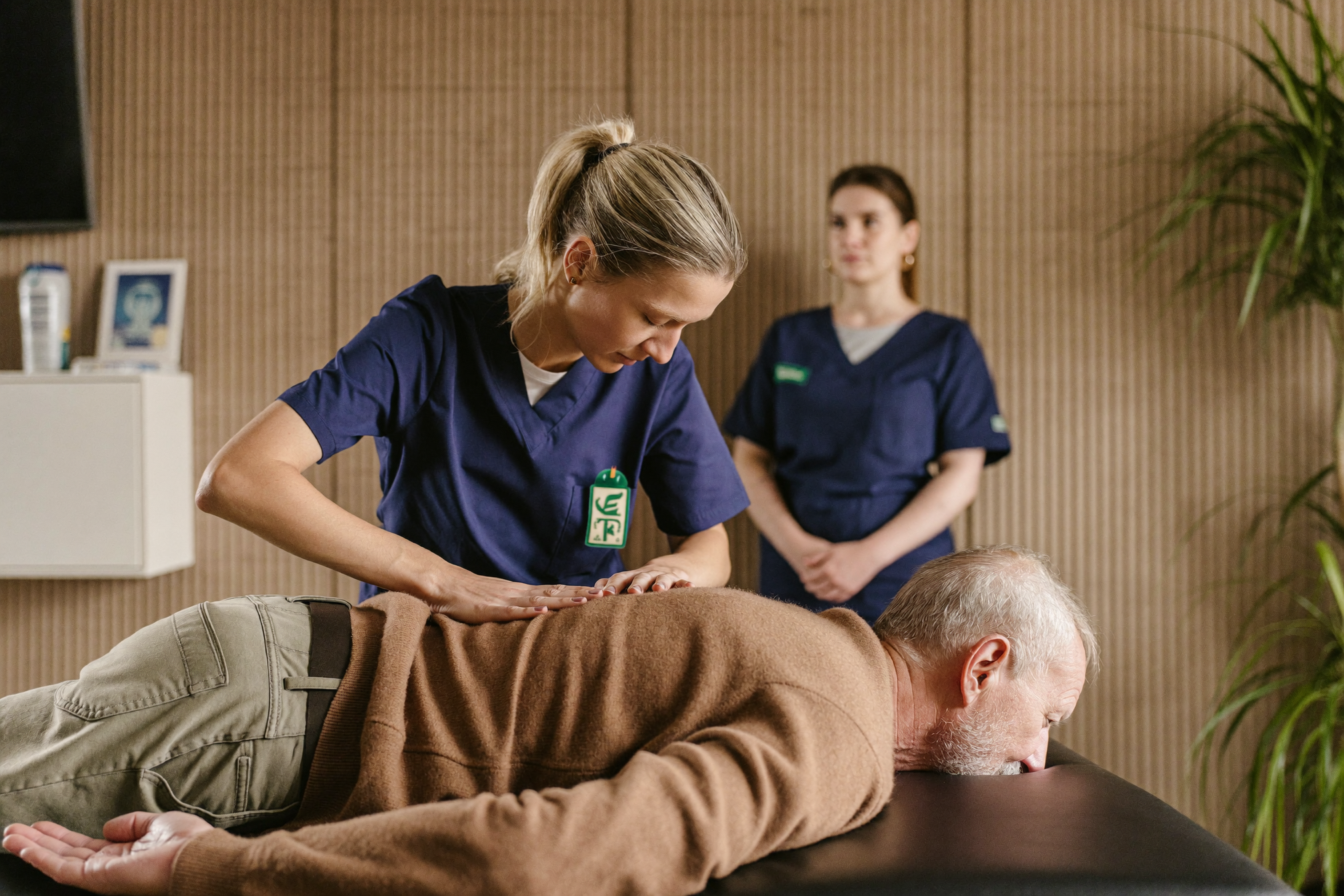
Your exam looks at your spine, posture, and movement. From there, care may combine spinal decompression, adjustments, soft-tissue therapy, and movement work to relieve pressure and rebuild support. You move through clear stages.
Relieving pressure and restoring healthy movement helps reduce pain and keeps the back more resilient. Because the spine anchors the whole kinetic chain, easing back trouble often helps the hips and knees too. Dr. Sarah Scharf builds care around lasting change.
How a healthy back shares the load — and what happens when it can't
Your lower back is built to distribute force, not absorb it in one place. Each spinal segment shares the work: the discs act as fluid-filled cushions that handle compression, the facet joints — the small paired joints at the back of each vertebra — guide and limit motion, and the nerve roots exit through openings between them, expecting a clear path. Layers of muscle and fascia coordinate the whole structure through every bend and lift.
Back pain usually starts when that load-sharing breaks down. Hours of sitting, repetitive lifting, or gradual disc thinning shift force onto structures that weren't designed to carry it: facet joints get compressed and inflamed, discs lose height under sustained pressure, and the openings where nerve roots pass can narrow enough to irritate them. Your body responds by tightening the surrounding muscles into a protective brace — helpful for a day or two, but that guarding itself compresses the spine further and restricts the very movement your discs rely on.
That's why rest alone so often disappoints. Lying low can calm a flare-up, but it doesn't redistribute the load that caused it — and discs, which have almost no blood supply, actually depend on movement to draw in fluid and nutrients. Lasting relief means restoring how your spine shares force, not just waiting out the pain.
Where the pain is actually coming from
A thorough exam looks at four structures that trade load back and forth. Any of them can be the primary pain generator — and they rarely fail alone.
Discs under sustained compression
When you sit or lift for hours, disc pressure stays elevated and fluid slowly squeezes out. A thinner disc handles shock poorly and passes more force to the joints behind it.
Facet joints taking over
These small joints are built to guide motion, not bear weight. When disc height drops or posture shifts load backward, they become inflamed and produce that focal ache that worsens when you arch or twist.
Nerve roots losing their space
A bulging disc or a narrowed opening can press on or chemically irritate a nerve root, sending pain, tingling, or weakness into the hip or leg.
Muscle guarding that overstays its welcome
Protective tightness is your nervous system splinting the area. Left running for weeks, it compresses the spine, restricts blood flow, and becomes a pain source of its own.
The treatment sequence: unload, calm, rebuild
Care moves through phases, each preparing the spine for the next — without surgery, injections, or long-term medication.
Unload the spine
Non-surgical lumbar decompression gently stretches the spine to reduce pressure inside the discs and open space around irritated nerve roots, while gentle chiropractic adjustments restore motion to restricted segments.
Calm the tissue
Class IV deep tissue laser and focused shockwave therapy stimulate circulation and cellular repair in inflamed joints and strained muscle, while myofascial cupping and the Graston Technique release the guarded layers that keep the spine compressed.
Rebuild the support
A daily stretching and strengthening program retrains the deep stabilizers so your spine can share load properly on its own — the phase that determines whether relief lasts.
Why the pieces matter together
Each therapy addresses a different link in the cycle. Skipping one tends to leave the loop intact.
Decompression feeds the disc
Reducing pressure lets the disc draw in fluid and nutrients — the imbibition process it depends on to repair. Many patients feel pressure begin to ease within the first few sessions.
Soft tissue work releases the brace
Until guarding muscles let go, adjustments and exercise are fighting a locked system. Freeing those layers makes every other therapy more effective.
Habits close the loop
Anti-inflammatory nutrition guidance and simple movement habits — how you sit, lift, and break up the day — keep the load from piling back onto the same structures.

Find out which structures are carrying too much
Dr. Sarah Scharf starts with a detailed exam of your spine, posture, and movement to identify where the load-sharing has broken down — then builds a phased plan to correct it. Whether you want to get back on the Marin trails or simply get through a workday comfortably, that's where lasting relief starts.
Schedule your back pain evaluationFAQFrequently Asked Questions
It is for patients with back pain from discs, joints, muscles, or nerves who want a non-surgical path.
Care is non-invasive and comfortable, often combining decompression with movement work.
Your timeline depends on the cause and severity, which the exam helps clarify.
Because the spine anchors the body, easing back pain can also help the hips and knees.
There is no downtime. Many patients feel pressure ease early, with steady gains over time.
 Marin Joint Health
Lasting relief from knee and joint pain without surgery
If knee or joint pain is holding you back, our doctors treat the root cause, not just the symptoms, without surgery or drugs.