
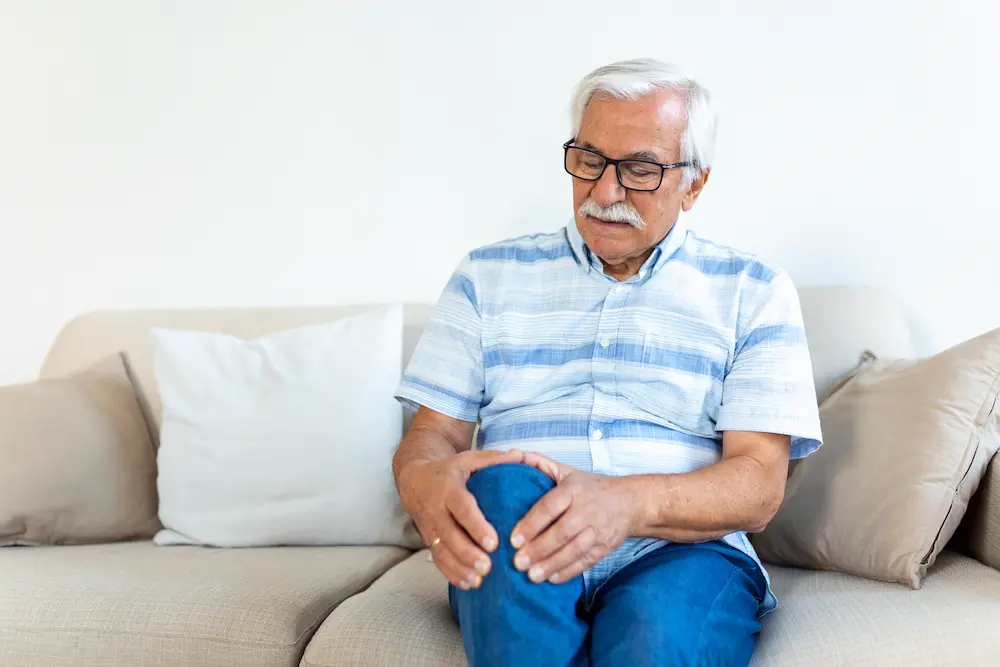
Knee pain after 50 is not simply an inevitable part of getting older – though it’s common enough that many people accept it as such. There are specific biological and mechanical changes that make the knee more vulnerable in the second half of life, and understanding them points directly toward what can be done about it. At Marin Joint Health in Novato, the majority of patients we treat for knee pain are in their 50s, 60s, and 70s, and most of them have far more options than they realize.
What Changes in the Knee After 50
Several processes converge in midlife to increase the knee’s vulnerability to pain and degeneration. None of them are instant – they build gradually over years – but by the time most people notice significant symptoms, multiple factors are typically at work simultaneously.
Cartilage Thinning and Reduced Water Content
Articular cartilage is roughly 70-80% water in healthy young tissue. That water content is what gives cartilage its ability to absorb shock and distribute load. With age, the proteoglycans that hold water in the cartilage matrix gradually decrease in concentration. The cartilage becomes stiffer, less resilient, and more susceptible to mechanical damage from the same loads it handled easily at 30.
This process accelerates when the joint is overloaded, poorly aligned, or when chronic inflammation is present. By the time an X-ray shows joint space narrowing – the classic sign of osteoarthritis – cartilage thinning has been underway for years.
Muscle Mass Loss (Sarcopenia)
Adults lose roughly 3-8% of muscle mass per decade after 30, with the rate accelerating after 60. The quadriceps – the primary shock absorbers of the knee – are particularly affected. Weaker quads mean the knee joint itself must absorb more of the compressive force from each step, stair, and movement. The muscles that were designed to take the load aren’t doing their job as well, so the joint pays the price.
This is one reason knee pain in older adults often responds so well to muscle-rebuilding interventions alongside joint treatment. Restoring quad strength doesn’t just feel good – it mechanically unloads the joint.
Reduced Synovial Fluid Production
Synovial fluid lubricates the joint and delivers nutrients to the cartilage. Production of this fluid decreases with age, and its composition changes – it becomes less viscous and less effective as a lubricant. The result is increased friction, reduced shock absorption, and less efficient nutrient delivery to cartilage tissue that already has a limited blood supply.
Hormonal Changes
Estrogen has a protective effect on cartilage and has anti-inflammatory properties in joint tissue. The sharp drop in estrogen at menopause is associated with an accelerated increase in knee osteoarthritis incidence in women – which is why women over 50 develop knee arthritis at significantly higher rates than men of the same age, despite lower rates earlier in life.
Testosterone decline in men has a similar, if more gradual, effect on muscle mass maintenance and systemic inflammation regulation. Both hormonal shifts contribute to the increased vulnerability of the aging knee.
Accumulated Mechanical Wear
By 50, most people have 40-plus years of walking, climbing, and movement behind them. If foot mechanics, hip alignment, or posture have been even slightly off during those decades, the abnormal forces they’ve been placing on the knee have been quietly accumulating. What was a minor biomechanical issue at 30 becomes a significant contributor to pain at 55 simply because the cumulative wear has crossed a threshold.
Increased Systemic Inflammation
Aging is associated with a gradual increase in baseline inflammatory markers – sometimes called inflammaging. This low-level chronic inflammation contributes to joint degeneration and amplifies pain perception. Metabolic changes that often accompany midlife – increased visceral fat, insulin resistance, dietary shifts – further drive inflammatory signaling that affects the joint directly.
Why “Just Rest It” Stops Working After 50
Younger joints respond to rest because the underlying tissue has a robust repair capacity. At 50 and beyond, the repair mechanisms are slower, less complete, and more dependent on good mechanical conditions and anti-inflammatory inputs to function at all. Rest removes the loading stimulus but doesn’t address any of the factors driving degeneration.
For many patients, the pattern becomes clear: knee pain after 50 doesn’t resolve with rest the way a younger injury might. It flares, partially improves, and then returns – often progressively worse each cycle. This is the joint’s repair capacity being outpaced by the ongoing degeneration and inflammatory load.
This is precisely why a comprehensive, multi-modal approach to treatment produces better results in this age group than any single intervention.
What Actually Works for Knee Pain After 50
At Marin Joint Health, our 12-week knee pain relief protocol was developed with this patient population in mind. The therapies it combines address the specific mechanisms driving age-related knee pain, not just the symptoms.
Rebuilding Joint Environment with Decompression and Laser
Knee-On-Trac decompression draws synovial fluid back into a joint that’s been compressed and poorly lubricated, improving the nutrient environment for whatever cartilage remains. Class 4 laser therapy addresses the cellular energy deficit in aging tissue – mitochondrial function declines with age, and photobiomodulation directly boosts ATP production in joint cells, improving their ability to maintain and repair tissue. These aren’t just symptomatic treatments. They’re creating conditions the aging joint needs for meaningful recovery.
Stimulating Tissue Repair with Shockwave
Focused shockwave therapy triggers the body’s healing cascade in the tendons, ligaments, and periarticular tissue surrounding the knee. In older patients, this healing cascade is present but sluggish – it needs a stimulus to activate. Shockwave provides that stimulus, driving new blood vessel formation and collagen remodeling in tissue that would otherwise remain in a chronic degenerative state.
Restoring Muscle Function
Addressing sarcopenia directly – through targeted strengthening exercises and Trigenics neuro-kinetic therapy – is essential for knee pain in this age group. Trigenics is particularly valuable because it overcomes the neurological inhibition that prevents aging muscles from fully activating even when the patient is trying to strengthen them. The exercise program in the protocol is designed specifically for patients with current pain and limited tolerance, progressing gradually as strength and comfort improve.
Correcting Biomechanics
Chiropractic alignment throughout the kinetic chain and custom orthotics address the accumulated mechanical contributors that have been loading the knee abnormally. Correcting these doesn’t reverse past wear, but it stops the ongoing abnormal force application that’s accelerating the degeneration further.
Anti-Inflammatory Nutrition
The nutrition component of the protocol directly addresses the systemic inflammatory environment that drives age-related joint degeneration. Reducing pro-inflammatory foods, increasing omega-3 intake, and supporting metabolic health are not peripheral concerns – they directly affect the inflammatory signaling in the joint tissue.
You’re Not Too Old to Get Better
This is something worth saying directly. Many patients over 60 or 70 come into our Novato clinic having been told – explicitly or implicitly – that their age means little can be done short of surgery. That’s not accurate. Cartilage can improve its hydration and metabolic function. Muscles can be rebuilt at any age with appropriate stimulus. Inflammation can be reduced. Biomechanics can be corrected.
The goal isn’t to return a 65-year-old knee to what it was at 30. The goal is meaningful, lasting reduction in pain and restoration of the function that allows you to walk, hike, travel, and stay active on your own terms. That’s achievable for most patients who commit to a comprehensive program – regardless of age.
If you’re over 50 and dealing with knee pain in Marin County, we’d like to give you an honest assessment of what’s driving it and what a realistic treatment plan looks like for your situation. Call (415) 818-0243 or schedule a consultation online at our Novato clinic. Flexible payment plans are available.