

Neck Pain
Take the extra weight off your neck.
A stiff, aching neck can throw off your sleep, your focus, and your whole day. We work to find the source and ease it without drugs or surgery.
Conservative care for knee and joint pain.
At a glance
Day one
We pinpoint which joints, muscles and nerves are involved.
Drug-free
No injections or surgery.
Posture tools
Habits that stop the pattern coming back.
At a glance
Neck pain, explained
01
What it is
Neck pain often comes from joint restriction, muscle tension, poor posture, or nerve irritation in the cervical spine. It can stay local or radiate into the shoulders and head. Care here looks past the sore spot to what is actually driving it.
02
How it works
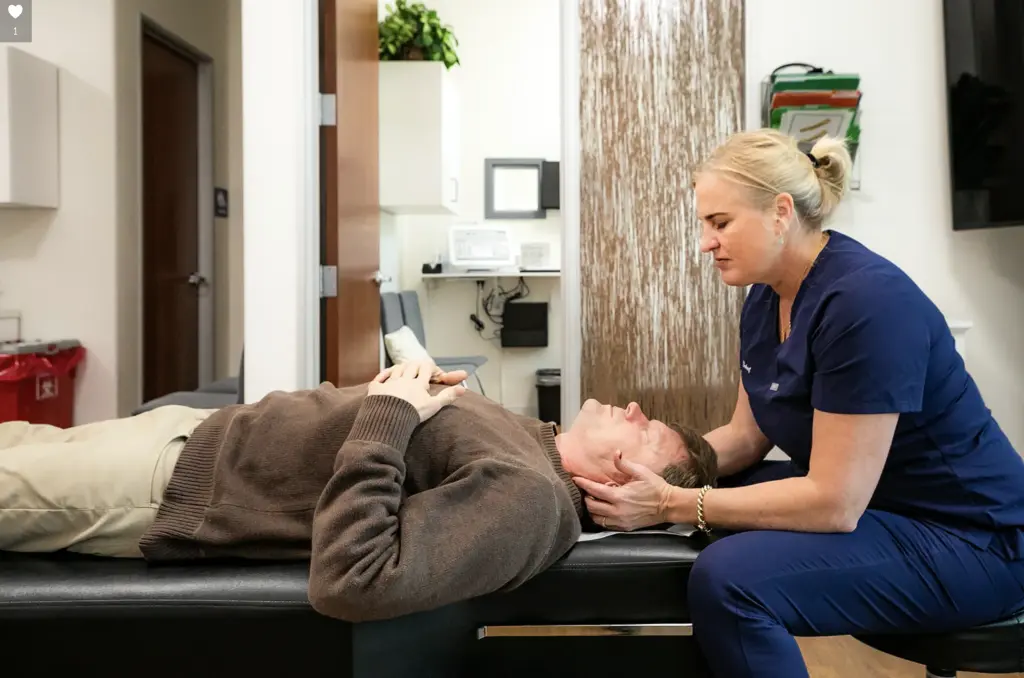
We assess your neck, posture, and movement, then build a plan that may include gentle adjustments, soft-tissue work, and therapies that calm pain and support healing. As alignment and movement improve, the neck has a chance to settle.
03
How it helps
Easing the real cause helps reduce pain, restore movement, and protect against repeat flares. Dr. Sarah Scharf, DC, treats the neck as part of the whole chain, since what happens there often affects the shoulders, head, and posture.
Understand why you hurt
Your head weighs more than you think, at least to your neck
Balanced directly over your shoulders, your head loads your cervical spine with ten to twelve pounds, a weight it manages effortlessly. But necks rarely spend the day balanced anymore. Every inch your head drifts forward toward a screen roughly doubles the effective load your neck muscles and joints must hold, and most of us hold that position for hours at a time.
That sustained forward-head posture concentrates force on specific structures. The facet joints, small paired joints that guide each neck vertebra, get pinned in a compressed position. The suboccipital muscles, a group of short muscles at the base of your skull, grip constantly to keep your eyes level, while the deep muscles at the front of the neck that should share the work gradually switch off. Meanwhile, the openings where nerve roots exit the cervical spine can narrow, which is why neck trouble so often radiates into the shoulder blade, the shoulder, or down the arm as aching, tingling, or heaviness.
The result is a neck that hurts not because something is torn, but because it has been working from a losing position for years. That’s actually encouraging news: positions and patterns can be changed, and the tissue they’ve been straining can settle once they are.
Day one: we explain
Before any treatment, we show you what your posture is doing to your neck, and what we’re going to change.
What’s going on
What screen posture does to the cervical spine
Four changes build quietly over years of desk work and phone time. Together they explain most of the neck pain we see.
01
Compressed facet joints
Held in a forward, extended position, these joints bear load all day instead of gliding freely. They respond with stiffness, a deep ache at the base of the neck, and pain that sharpens when you look up or turn to check a blind spot.
02
Suboccipital tension
The small muscles where your skull meets your spine work overtime to keep your gaze level against a forward-drifting head. Their constant grip creates the band of tightness many patients feel at the skull base by mid-afternoon.
03
Irritated nerve roots
When disc and joint changes crowd the exits where nerves leave the neck, symptoms travel, into the trapezius, the shoulder blade, or down the arm. Arm symptoms are often a neck problem in disguise.
04
Deep stabilizers offline
The deep neck flexors that should hold your head balanced weaken with disuse, leaving the surface muscles to do a job they weren’t built for, which is why those muscles always feel tight no matter how much you stretch them.
How we help
How we unwind it
Treatment works on the joints, the tissue, and the pattern, all without drugs, injections, or surgery.
Restore joint motion
Gentle, precise chiropractic adjustments free the facet joints that have been pinned in compression, often paired with non-surgical cervical decompression to relieve pressure on irritated discs and nerve roots.
Release the overworked tissue
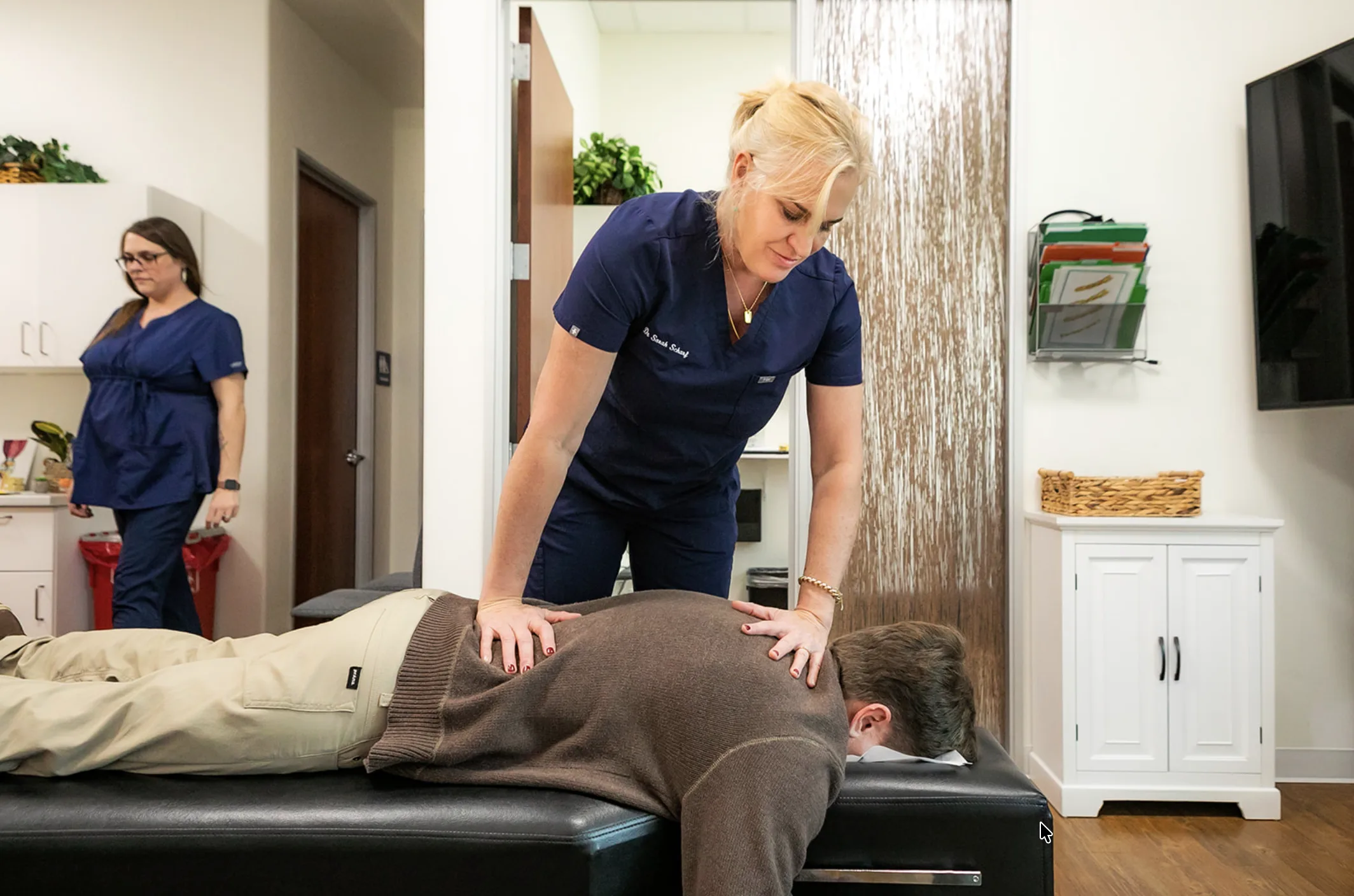
Targeted soft tissue work, myofascial cupping, the Graston Technique, and hands-on suboccipital release, lets muscles that have been bracing for years finally let go, while Class IV laser therapy calms inflammation in the deeper layers.
Reactivate the support system
Trigenics neuro-kinetic therapy and a short daily exercise program wake up the deep stabilizers, so your head is carried by the muscles actually designed for the job.
Honest about limits
If your problem needs more than conservative care, we’ll tell you.
Some problems need a different plan, and a few need a specialist or a surgeon. If your exam shows that, we say so on day one and refer you on, before you invest in care that won’t help.
If conservative care isn’t the right fit, we tell you and refer you to the appropriate specialist.

Complete approach. Complete care.
Keeping your neck out of the losing position
Because posture created the problem, your plan includes the tools to stop recreating it between visits.
01
Workstation and habit coaching
Small changes to screen height, break rhythms, and phone habits cut the hours per day your neck spends under multiplied load.
02
Strength that holds the correction
A few minutes of daily targeted exercise maintains the balance between deep and surface muscles that treatment restores.
03
The whole-chain view
Dr. Sarah Scharf, DC, assesses the upper back and shoulders alongside the neck, since a stiff thoracic spine forces the neck to compensate for motion it has lost.
You learn to manage it yourself: workstation and habit coaching keeps your neck out of the losing position between visits.
Feel better. Live better.
Take the extra weight off your neck
If your neck aches by afternoon, or symptoms are creeping into your shoulders or arms, an evaluation can pinpoint which joints, muscles, and nerves are involved, and what it will take to unwind the pattern for good.
Patient reviews
Finally explained. In their own words.
Read what patients have shared about their care.
-
I had an ongoing knee issue from an old ACL injury, and the team at Marin Joint Health provided wonderful care and effective treatment. My knee has improved significantly, and I now have much less pain. I'm so grateful for their expertise and highly recommend them to anyone dealing with similar issues.
-
I love the quality of care I’m receiving! And Dr. Scharf and her staff are wonderful! I’m so glad I signed up for this program to treat my knees, osteoarthritis and meniscus tears!
-
My experience has been transformative for me. My knee pain kept me from being active. I feel like I now have freedom to return to my life being active and healthy. The staff and patients make each visit so pleasant, there is a general feeling of positive healthy attitudes and healing shared during my visits. My only regret is not having found them sooner.
-
I had problems with my knees and it was painful to walk. I started treatment with Dr. Patrick and Gabriela, and now I walk much better and the pain is much less.
-
I have been coming to the clinic for three months. From arriving with excruciating pain in both knees I can now say that my knees are stable, mostly pain free, and I am getting stronger. My goal was to avoid surgery and stay active. Dr Scharf and her team Dr Chu and Gabriella are amazing. They are so dedicated to helping me feel better. I…
Individual results vary.
FAQ
Frequently Asked Questions
Still have questions? Call us and we’ll explain exactly how we can help.
It is for patients with stiffness, aching, or nerve-related neck pain who want relief without drugs or surgery.
Care is gentle and hands-on. Many patients notice easier movement as treatment progresses.
The plan depends on the cause and how long symptoms have lasted, set after your exam.
Neck pain often ties into posture and the upper back, so your plan may address those too.
There is no downtime. Relief usually builds across a series of visits.

Feel better. Live better.
Finally understand why you hurt—and what you can do about it.
We explain what we find, build a complete conservative plan and teach you how to stay ahead of it for life.