
Home Services Focused Shockwave Therapy
Focused Shockwave Therapy
Restart the healing that stalled.
Stubborn, long-standing pain sometimes needs a wake-up call. Focused shockwave therapy jumpstarts healing in tissue that has stalled.
Conservative care for knee and joint pain.
At a glance
Non-invasive
Acoustic pulses only: no surgery, no injections.
Brief sessions
A short tapping sensation most patients tolerate easily.
One system
Sequenced with laser, movement work and your home program.
At a glance
Focused shockwave therapy, explained
01
What it is
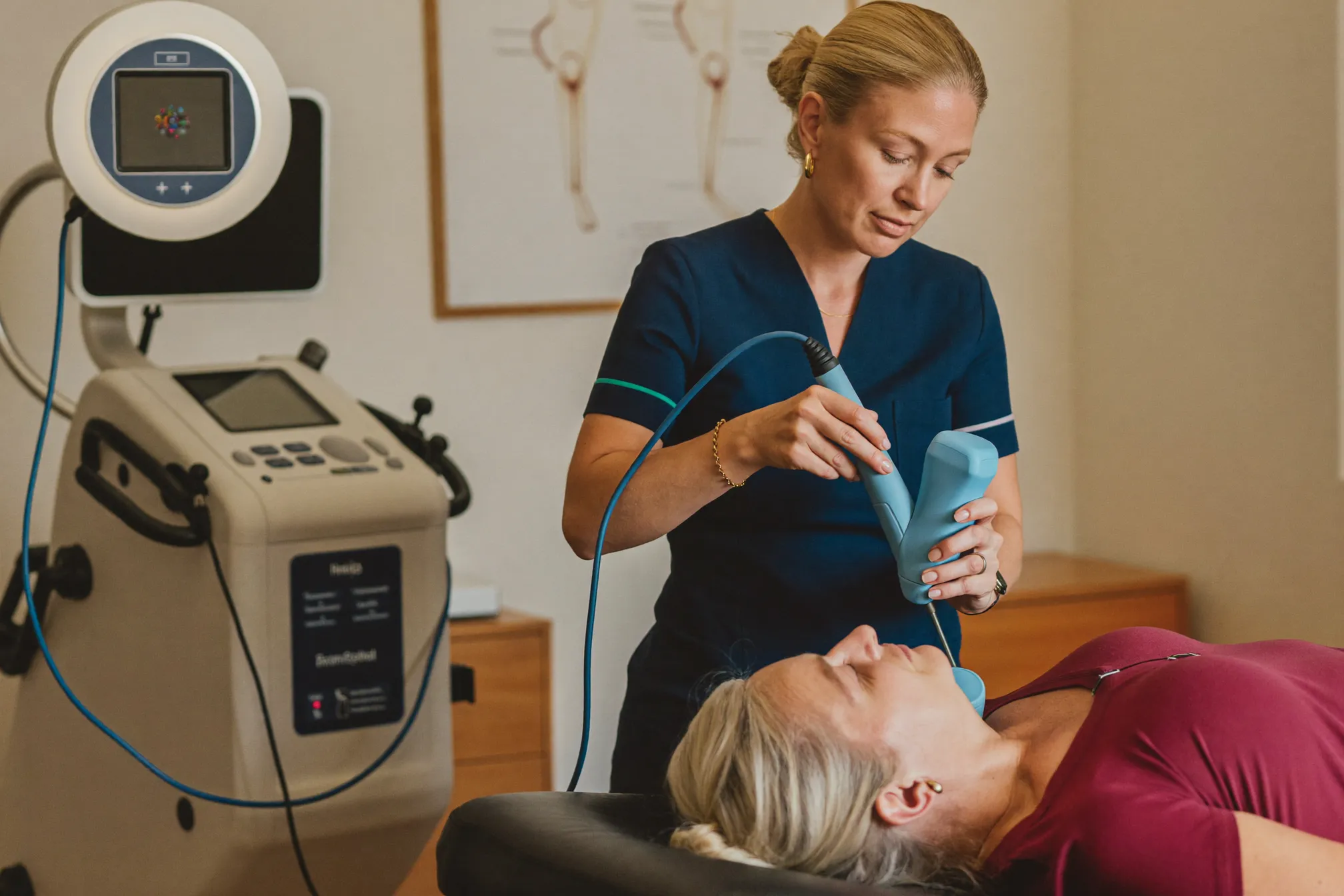
Focused shockwave therapy uses high-energy sound waves to stimulate repair in damaged or chronically irritated tissue. It is non-invasive and especially useful for pain that has lingered despite other approaches. It is a key tool in the way Dr. Sarah Scharf, DC, treats persistent knee and joint problems.
02
How it works
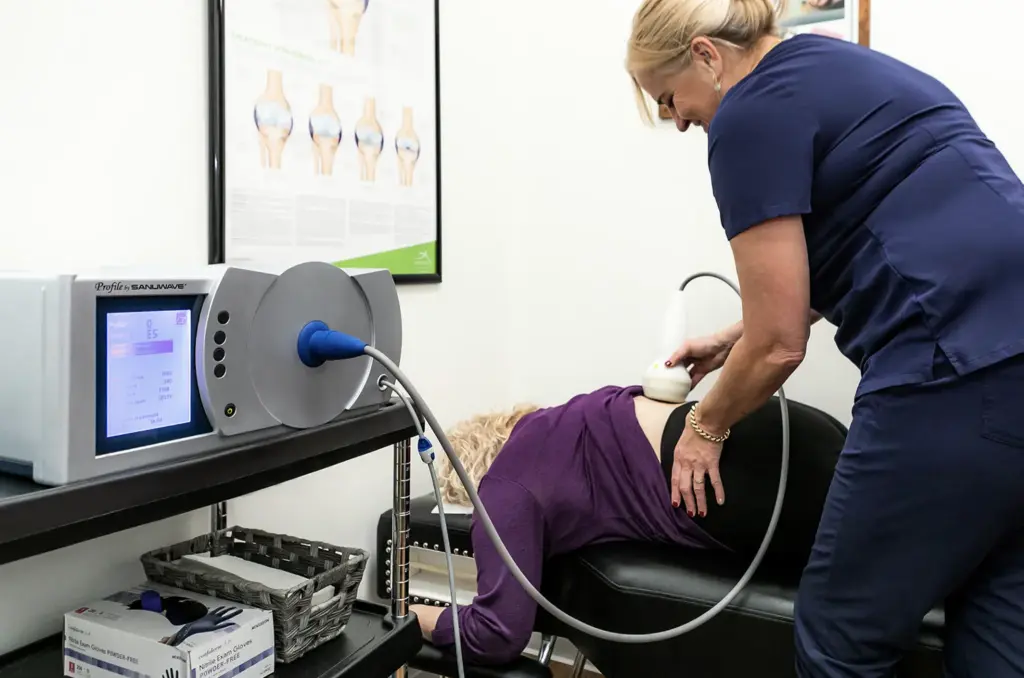
A handpiece delivers precise pulses of acoustic energy into the target area. Those pulses increase blood flow, trigger the body’s repair response and help break the cycle of chronic inflammation. You may feel a tapping sensation during treatment, which most patients tolerate easily.
03
How it helps
Some tissue gets stuck in a low-grade injured state and stops healing on its own. Shockwave nudges that process back into motion, which can reduce pain and improve function where other methods stalled. Within the protocol, it targets the deeper, more stubborn sources of knee pain.
Understand why you hurt
When Healing Simply Stalls
A healthy injury follows a schedule. Inflammation flares, repair cells arrive, new tissue is built, and the pain fades over a few weeks. But some tendon and ligament problems never finish that schedule. The initial inflammation quiets down, yet the tissue underneath never fully rebuilds. It settles into a kind of limbo that clinicians call failed healing, or chronic tendinopathy.
This is the pain that outlasts every reasonable timeline: the Achilles that has ached for a year, the heel that greets you every morning, the deep ligament that never quite came back. Rest does not fix it, because rest is not what the tissue is missing. What it is missing is a signal, a biological instruction to start building again, and a stalled tendon has stopped generating one on its own.
Focused shockwave therapy is, at its core, a way to send that missing signal. It does not mask pain or force tissue to move; it prompts the body to restart the repair process it abandoned.
Day one: we explain
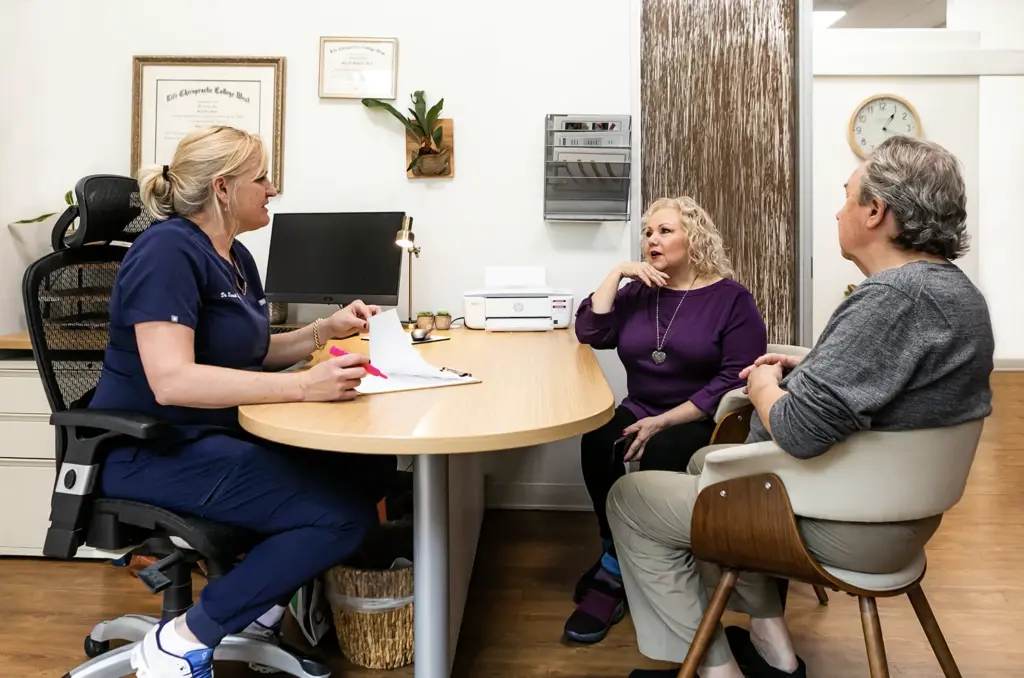
Before any treatment, we show you what is keeping your tissue stuck, and whether shockwave can restart it.
How it works
How Sound Waves Restart Biology
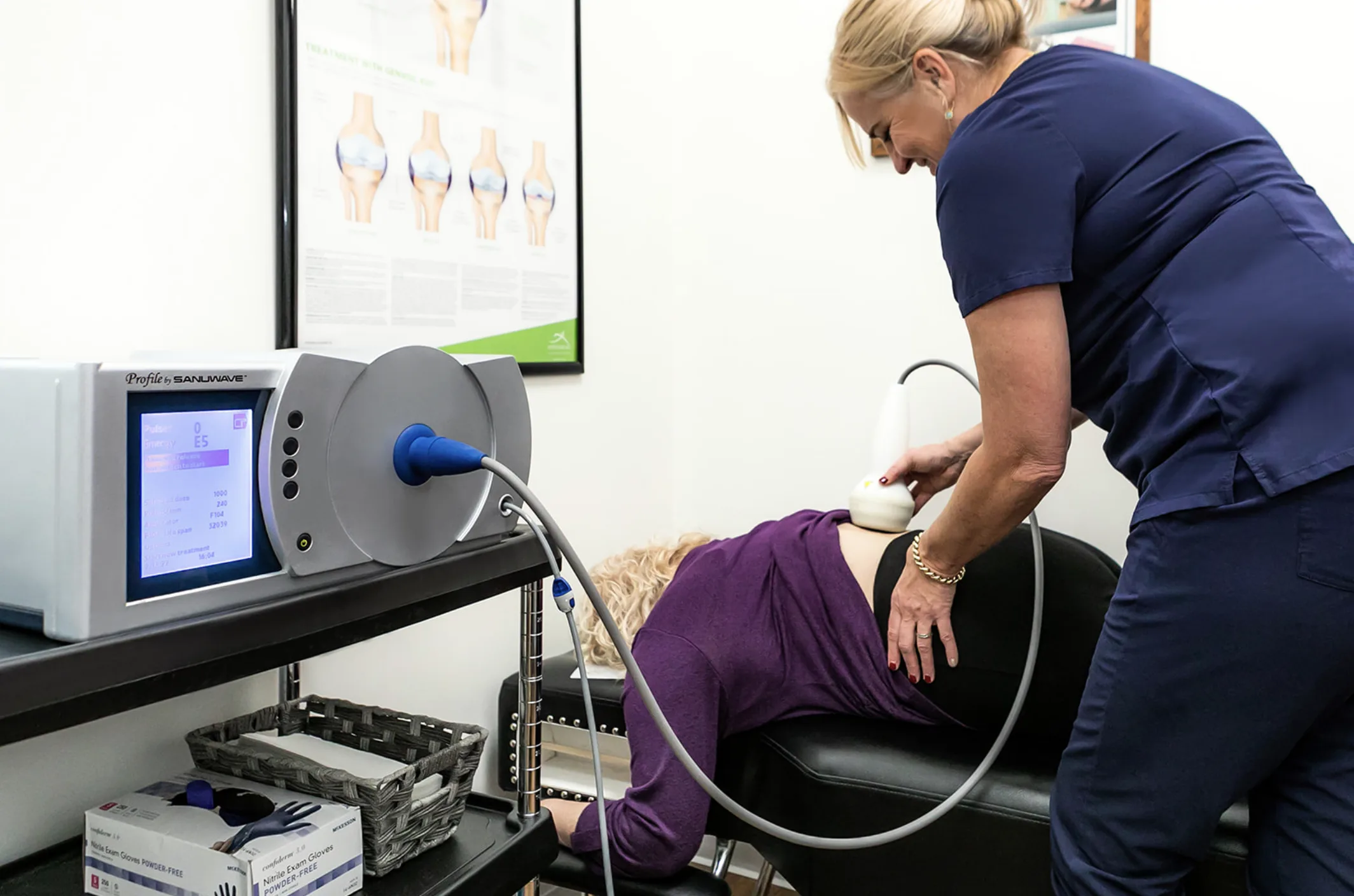
The mechanism is mechanotransduction: the body’s ability to convert a physical force into a chemical response. Focused acoustic pulses are the force; a cascade of repair signals is the response.
01
Focused acoustic energy, aimed deep
Unlike scattered surface waves, focused shockwaves converge energy at a chosen depth. That lets the pulse reach a deep ligament or a tendon attachment precisely, rather than dissipating in the tissue above it.
02
Cells read the mechanical message
When those pulses reach the stalled tissue, the cells sense the mechanical stress and respond chemically, releasing growth factors and signaling molecules that summon the repair machinery back to the site.
03
New microcirculation follows
Part of that response is angiogenesis, the growth of tiny new blood vessels. Fresh microcirculation carries oxygen and nutrients into tissue that had become poorly supplied, a common reason healing stalled in the first place.
04
A controlled reset, not damage
The goal is to nudge dormant tissue back into an active repair state. The brief tapping you feel is that stimulus at work, and mild soreness for a day or two often signals the tissue is responding.
Who it’s for
The Problems It’s Built to Reach
Shockwave earns its place with the stubborn, deep, chronic cases: the ones that have outlasted rest and simpler care.
Chronic tendinopathy
Achilles, patellar and other long-suffering tendons that have been irritated for months are the signature use. These are exactly the tissues most prone to stalling in a failed-healing state.
Plantar fascia and heel pain
That sharp first-step-of-the-morning heel pain often comes from fascia stuck in chronic irritation. Focused energy can reach the attachment where the trouble concentrates.
Deep ligaments and attachments
Structures too deep for surface therapies to influence are where focused shockwave’s aimed energy makes the difference.
Honest about limits
If shockwave isn’t the answer, we’ll tell you.
Mild soreness for a day or two afterward is normal, but not every pain is a stalled-healing problem. If your exam shows you need something different, or a surgeon, we say so on day one.
If conservative care isn’t the right fit, we tell you and refer you to the appropriate specialist.
Complete approach. Complete care.
Where Shockwave Fits Your Protocol
Shockwave is the therapy we reach for when tissue needs a jumpstart, and it works best surrounded by the right support.
01
For the cases that plateaued
When rest, stretching and gentler care have taken you as far as they can, shockwave targets the deeper, more resistant source of the pain.
02
Sequenced with laser and movement
Once shockwave has triggered the repair response, Class IV laser can support the cellular work, and progressive loading gives the rebuilding tissue a direction to grow.
03
Measured over a series
Improvement usually builds gradually across several sessions as new tissue matures, which is why Dr. Scharf tracks your response and adjusts as you go.
You learn to manage it yourself: every step comes with the home movements that keep your tissue loading well between visits, and long after your plan ends.
Feel better. Live better.
Wake Up Tissue That Stopped Healing
If a tendon or ligament has been sore for months with no real progress, the problem may be a stalled repair signal, not something rest can fix. Let’s assess whether shockwave can restart it.
Patient reviews
Finally explained. In their own words.
Read what patients have shared about their care.
-
I had an ongoing knee issue from an old ACL injury, and the team at Marin Joint Health provided wonderful care and effective treatment. My knee has improved significantly, and I now have much less pain. I'm so grateful for their expertise and highly recommend them to anyone dealing with similar issues.
-
I love the quality of care I’m receiving! And Dr. Scharf and her staff are wonderful! I’m so glad I signed up for this program to treat my knees, osteoarthritis and meniscus tears!
-
My experience has been transformative for me. My knee pain kept me from being active. I feel like I now have freedom to return to my life being active and healthy. The staff and patients make each visit so pleasant, there is a general feeling of positive healthy attitudes and healing shared during my visits. My only regret is not having found them sooner.
-
I had problems with my knees and it was painful to walk. I started treatment with Dr. Patrick and Gabriela, and now I walk much better and the pain is much less.
-
I have been coming to the clinic for three months. From arriving with excruciating pain in both knees I can now say that my knees are stable, mostly pain free, and I am getting stronger. My goal was to avoid surgery and stay active. Dr Scharf and her team Dr Chu and Gabriella are amazing. They are so dedicated to helping me feel better. I…
Individual results vary.
FAQ
Frequently Asked Questions
Still have questions? Call us and we’ll explain exactly how we can help.
It is well suited to patients with chronic tendon or soft-tissue pain that has not responded to rest or basic care.
You will feel a rapid tapping during the session. It is brief, and most people handle it well.
Sessions are short. The number in your plan depends on how your tissue responds, which Dr. Scharf tracks over time.
Mild soreness for a day or two afterward is normal and usually a sign the tissue is responding.
There is no real downtime. Improvement usually shows up gradually over a series of treatments.

Feel better. Live better.
Finally understand why you hurt—and what you can do about it.
We explain what we find, build a complete conservative plan and teach you how to stay ahead of it for life.