

Shoulder Pain
Get your reach back.
When your shoulder hurts, simple things like reaching, lifting, and sleeping get hard. We help restore comfortable, confident movement.
Conservative care for knee and joint pain.
At a glance
Day one
We look at the whole shoulder system, not just the joint.
Phase by phase
Free the platform, repair the tissue, reset the timing.
Load-ready
A graded return to reaching and lifting.
At a glance
Shoulder pain, explained
01
What it is
Shoulder pain relief applies our restorative approach to one of the body’s most mobile and complex joints. It combines hands-on techniques with targeted therapies to reduce pain and rebuild function. The focus is on healing tissue and restoring proper movement, not just masking symptoms.
02
How it works
We begin by pinpointing what is limiting and irritating the shoulder. Therapies then work to calm pain and support healing, while movement work restores range of motion and strength. Each phase is matched to how your shoulder responds.
03
How it helps
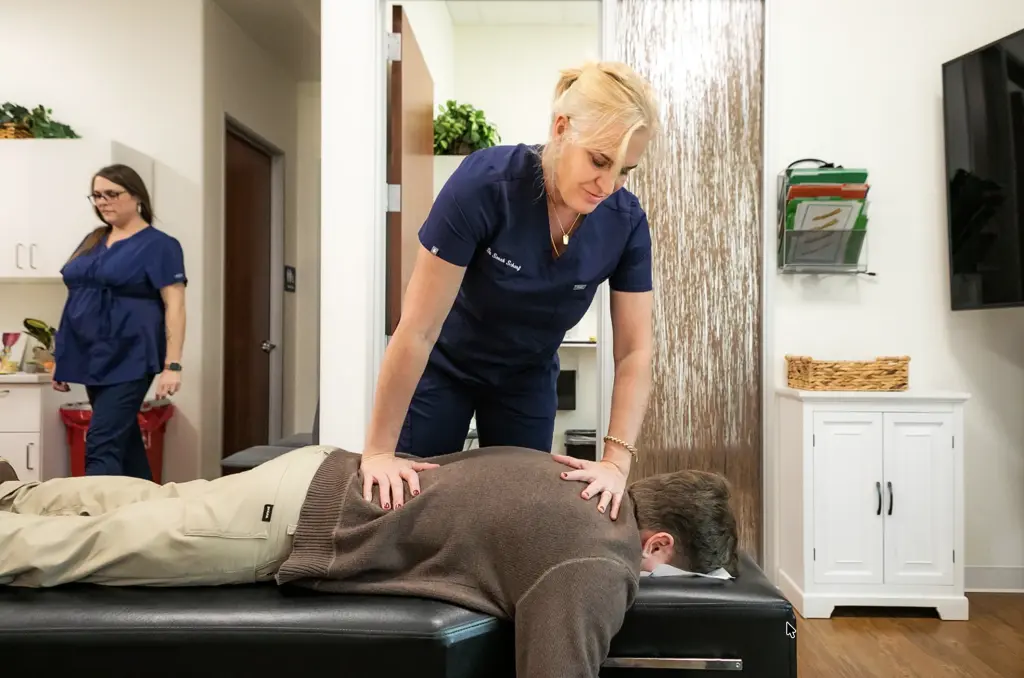
Shoulder problems tend to linger and limit far more than people expect. Restoring healthy movement helps you get back to reaching, lifting, and sleeping without a second thought. Dr. Sarah Scharf, DC, treats the shoulder with the same root-cause focus she brings to every joint.
Understand why you hurt
Built for reach, not for armor: the shoulder’s trade-off
Your shoulder gives you the largest range of motion of any joint in your body, and it pays for that freedom with a design gamble: the ball of your upper arm is several times larger than the shallow socket it rests against, closer to a golf ball on a tee than a hip’s deep ball-and-socket. Almost none of the shoulder’s stability comes from bone. It comes from timing.
That timing belongs to two muscle systems working in concert. The rotator cuff, four muscles wrapping the ball, steers and centers it in the socket during every reach. And the scapula, your shoulder blade, must glide across your rib cage in precise rhythm with the arm; roughly a third of your overhead motion actually comes from the shoulder blade rotating, not the arm lifting. When either system falls out of sync, a cuff muscle weakened or inhibited by pain, a shoulder blade that hitches instead of glides, the ball rides slightly off-center and pinches tendons and bursa against bone with every lift. Repeat that a few thousand times and you have the impingement and tendon irritation behind most shoulder pain.
There’s a third player most people never suspect: the thoracic spine. A stiff, rounded upper back tips the shoulder blade forward and down, stealing the platform the arm needs to lift cleanly. Many stubborn shoulders don’t heal because the treatment never looks below the shoulder.
Day one: we explain
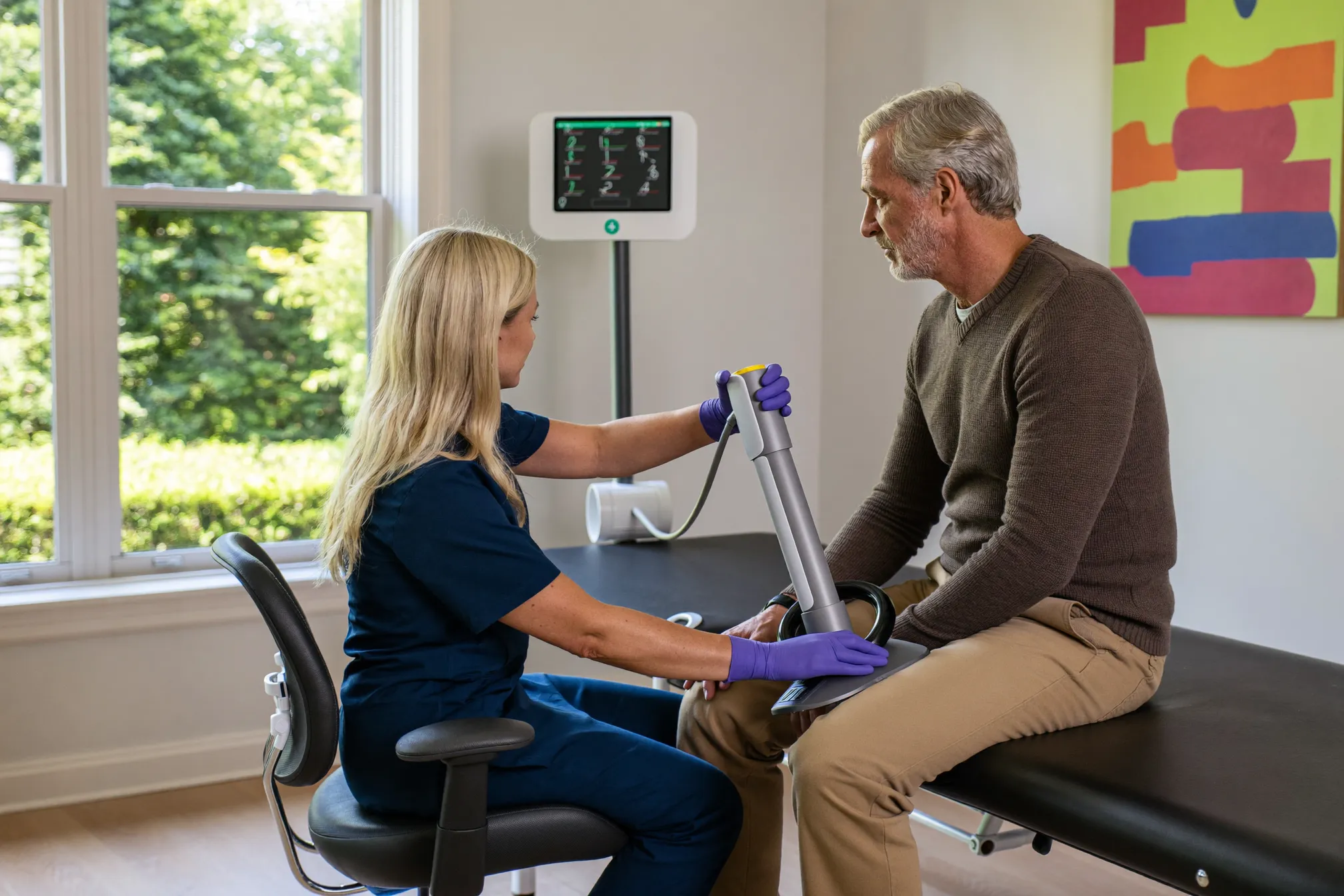
Before any treatment, we show you what is overloading your shoulder, and what we’re going to change.
What’s going on
The mechanics behind most shoulder pain
Shoulder problems usually trace to one of these breakdowns, and often more than one, since they feed each other.
01
A cuff that steers off-center
When rotator cuff muscles weaken or get neurologically inhibited by pain, the ball migrates upward in the socket, compressing the tendons and bursa in the narrow space beneath the tip of the shoulder.
02
Lost scapular rhythm
If the shoulder blade doesn’t rotate smoothly with the arm, the socket stops following the ball. Overhead motion jams, and the cuff tendons absorb loads they can’t sustain.
03
A stiff thoracic platform
Restricted upper-back joints and a rounded posture cut the range available before the shoulder even starts working, forcing the joint to strain at the end of every reach.
04
Tendons pushed past their capacity
Cuff tendons that are chronically overloaded degrade faster than they rebuild, the aching, weak, worse-at-night pattern of tendinopathy.
How we help
Restoring the system, phase by phase
Treatment rebuilds the shoulder from its foundation up, matching each therapy to the mechanism it corrects, no surgery, no injections.
Free the platform
Gentle chiropractic care restores motion to the thoracic spine and rib joints so the shoulder blade has a surface it can actually glide on.
Repair the tissue
Focused shockwave therapy and Class IV deep tissue laser stimulate repair in overloaded cuff tendons, while the Graston Technique and myofascial cupping restore glide between the muscle and fascial layers around the joint.
Reset the timing
Trigenics neuro-kinetic therapy re-activates cuff and scapular muscles that pain has switched off, patients often feel a strength change during the session, and progressive exercise turns that reconnection into lasting stability.
Honest about limits
If your problem needs more than conservative care, we’ll tell you.
Some problems need a different plan, and a few need a specialist or a surgeon. If your exam shows that, we say so on day one and refer you on, before you invest in care that won’t help.
If conservative care isn’t the right fit, we tell you and refer you to the appropriate specialist.

Complete approach. Complete care.
From pain-free to load-ready
A shoulder that no longer hurts isn’t the finish line; one that handles your life is.
01
Graded return to reaching and lifting
Your program progresses from pain-free range to real capacity, overhead reach, carrying, a tennis serve or golf swing, so the joint is ready for the demand, not just the exam room.
02
Sleep and daily positioning
Simple adjustments to sleeping position and desk setup take pressure off the healing tendons during all the hours between visits.
03
Whole-chain follow-through
Dr. Sarah Scharf, DC, rechecks the neck and upper back as your shoulder improves, since the shoulder rarely fails in isolation.
You learn to manage it yourself: every step comes with the movements and positioning habits that keep your shoulder load-ready.
Feel better. Live better.
Get your reach back
If your shoulder catches when you lift, aches at night, or has quietly shrunk what you’re willing to do with that arm, an evaluation can identify which part of the system broke down, the cuff, the blade, or the platform beneath them.
Patient reviews
Finally explained. In their own words.
Read what patients have shared about their care.
-
I had an ongoing knee issue from an old ACL injury, and the team at Marin Joint Health provided wonderful care and effective treatment. My knee has improved significantly, and I now have much less pain. I'm so grateful for their expertise and highly recommend them to anyone dealing with similar issues.
-
I love the quality of care I’m receiving! And Dr. Scharf and her staff are wonderful! I’m so glad I signed up for this program to treat my knees, osteoarthritis and meniscus tears!
-
My experience has been transformative for me. My knee pain kept me from being active. I feel like I now have freedom to return to my life being active and healthy. The staff and patients make each visit so pleasant, there is a general feeling of positive healthy attitudes and healing shared during my visits. My only regret is not having found them sooner.
-
I had problems with my knees and it was painful to walk. I started treatment with Dr. Patrick and Gabriela, and now I walk much better and the pain is much less.
-
I have been coming to the clinic for three months. From arriving with excruciating pain in both knees I can now say that my knees are stable, mostly pain free, and I am getting stronger. My goal was to avoid surgery and stay active. Dr Scharf and her team Dr Chu and Gabriella are amazing. They are so dedicated to helping me feel better. I…
Individual results vary.
FAQ
Frequently Asked Questions
Still have questions? Call us and we’ll explain exactly how we can help.
It is for patients with shoulder pain, stiffness, or weakness who want to avoid surgery and restore movement.
Care is gentle and hands-on, and most patients notice movement getting easier over time.
Shoulders heal at their own pace, and your plan sets a realistic timeline after the exam.
Sticking with the movement work between visits is key to regaining full function.
There is no downtime. Range of motion and comfort usually improve gradually through care.

Feel better. Live better.
Finally understand why you hurt—and what you can do about it.
We explain what we find, build a complete conservative plan and teach you how to stay ahead of it for life.