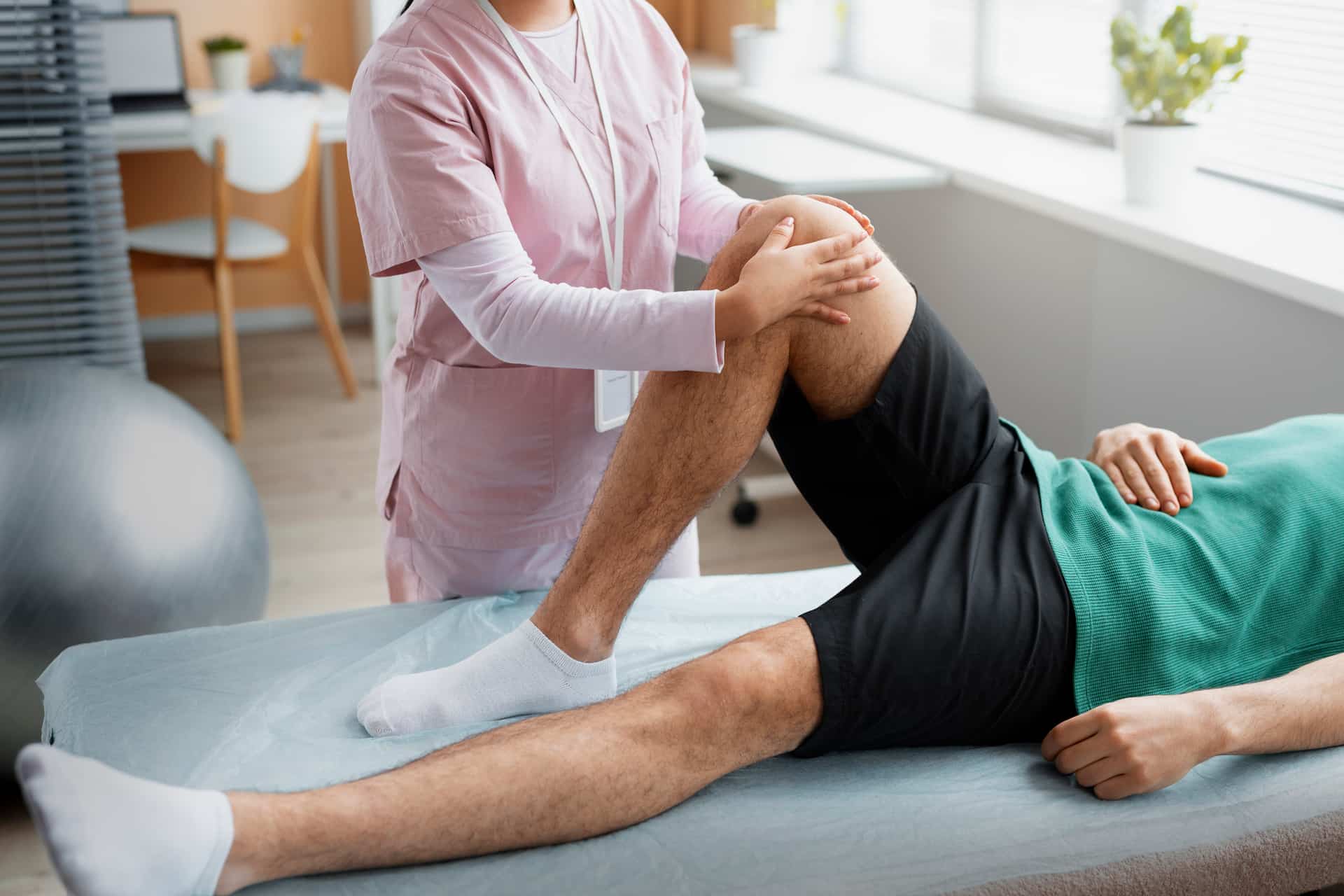
One of the most common things Dr. Sarah Scharf tells new patients at Marin Joint Health is that their knee pain is not coming entirely from their knee. The foot, ankle, hip, and spine all directly influence how load travels through the knee with every step. When any of those structures are misaligned or dysfunctional, the knee pays the price – often for years before anyone connects the dots. Understanding this is the key to understanding why the treatment approach here is so different from standard care.
What Is the Kinetic Chain?
The kinetic chain is a concept from biomechanics that describes how the body’s joints and segments work together as an interconnected system rather than independently. When you walk, run, climb stairs, or simply stand up from a chair, movement does not happen in one isolated joint. Forces travel up and down through a chain of connected structures: foot to ankle to knee to hip to pelvis to spine and back again.
In a well-functioning kinetic chain, each segment moves properly, absorbs its share of load, and passes forces along without creating excessive stress at any single point. When one segment is stiff, weak, or misaligned, it disrupts the chain. The segments above and below it have to compensate – and the joint that ends up compensating most in the lower body is almost always the knee.
How the Foot Affects the Knee
Your feet are the foundation of the entire kinetic chain. Every force that travels up through the body starts at ground contact with the foot. When foot mechanics are off, the effects are felt throughout the chain above it.
Overpronation
Overpronation – the inward rolling of the foot during weight-bearing – is one of the most common foot mechanics problems. When the foot rolls inward excessively, the lower leg rotates inward with it. That internal tibial rotation changes the angle at which the knee is loaded. The kneecap is pulled off its normal tracking path, the inner knee structures are compressed, and the outer structures are placed under tension. Every step repeats this abnormal stress pattern thousands of times per day.
Over time, overpronation contributes to patellofemoral pain, IT band syndrome, medial knee pain, and accelerated cartilage wear on the inner compartment of the knee. Many patients with chronic knee pain have been dealing with overpronation for years without ever being evaluated for it.
Flat Arches and High Arches
Both extremes – collapsed arches and excessively high arches – alter how shock is absorbed at the foot and distributed upward. Flat-arched feet tend to pronate excessively. High-arched feet tend to be rigid and poor at absorbing impact, passing more force directly up through the knee with every step. Neither is the way the foot was designed to function, and both create downstream effects at the knee.
Ankle Stiffness
Limited ankle dorsiflexion – restricted upward bend of the ankle – forces compensatory movement at the knee and hip during squatting, stair use, and walking. The knee often collapses inward to compensate for what the ankle cannot do, creating the same internal rotation and loading problems described above.
How the Hip Affects the Knee
The hip joint sits directly above the knee, and hip dysfunction is one of the most consistent findings in patients with chronic knee pain. The connection is direct and mechanical.
Hip Abductor Weakness
The hip abductors – particularly the gluteus medius – control whether the femur stays in a neutral position during single-leg loading or drops and rotates inward. When these muscles are weak, the femur collapses inward every time you put weight on that leg. That inward femoral rotation shifts the kneecap laterally out of its tracking groove and compresses the outer knee structures. This is one of the primary drivers of patellofemoral pain and IT band syndrome in active patients.
The key insight is that no amount of knee-focused treatment will fully resolve this problem if the hip weakness driving it is not also addressed. This is why isolated knee treatments so often produce incomplete results.
Hip Flexor Tightness
Tight hip flexors – extremely common in people who sit for long periods – pull the pelvis into an anterior tilt. That pelvic tilt increases lumbar lordosis, alters the alignment of the entire lower extremity, and changes the way the knee loads during movement. Hip flexor tightness also contributes to quad dominance patterns that overload the kneecap and patellar tendon.
Hip Joint Dysfunction
When the hip joint itself is restricted – from osteoarthritis, capsular tightness, or prior injury – normal hip movement is reduced and the knee is asked to compensate. Activities that require hip rotation, extension, or abduction end up being partially performed through the knee instead, creating stress patterns the knee is not designed to handle.
How the Spine and Pelvis Affect the Knee
The influence of the kinetic chain does not stop at the hip. Spinal and pelvic alignment directly affect lower extremity mechanics in ways that are easy to overlook when the pain is felt at the knee.
Pelvic Tilt and Asymmetry
When the pelvis is tilted or rotated – which is extremely common and often goes unnoticed – it creates leg length discrepancy and asymmetric loading through the hips and knees. One knee ends up absorbing more force than the other with every step. Over years, this asymmetric loading accelerates cartilage wear on one side more than the other, which is part of why knee osteoarthritis often presents more severely in one knee.
Lumbar Spine Dysfunction
The lumbar spine and sacroiliac joints influence how the pelvis moves during gait. When these structures are restricted or misaligned, normal pelvic rotation during walking is reduced. The body compensates through increased rotation at the hip and knee, creating stress at joints that were not designed to handle that rotational load.
Why Standard Knee Treatments Often Fall Short
This is the core of why so many patients cycle through physical therapy, cortisone injections, and conventional chiropractic without getting lasting relief. Those treatments address the knee directly – the painful joint, the inflamed tissue, the weak quad. But they do not correct the upstream and downstream mechanics that are creating the abnormal forces on the knee in the first place.
When the foot is still overpronating, the hip is still weak, and the pelvis is still asymmetric, the knee is still under the same abnormal load after treatment as it was before. Symptoms may quiet temporarily, but the mechanical drivers are still there, and the pain comes back.
The Full Kinetic Chain Approach at Marin Joint Health
The reason chiropractic care forms the structural foundation of Dr. Scharf’s knee protocol is precisely because of kinetic chain mechanics. Every patient evaluation at Marin Joint Health includes assessment of the full chain – foot mechanics, ankle mobility, hip strength and range of motion, pelvic symmetry, and lumbar alignment – not just the knee.
Chiropractic adjustments to the spine, pelvis, hips, and ankles correct the alignment issues above and below the knee. Custom Foot Levelers orthotics correct the mechanics at the base of the chain. Trigenics Neuro-Kinetic Therapy resets the muscle activation patterns that have adapted around the dysfunction. And the progressive exercise program in the protocol specifically targets the hip and ankle muscles – not just the knee – for exactly this reason.
All of this is delivered as part of Dr. Scharf’s 12-week knee pain relief protocol – a structured nine-therapy program designed to address every layer of chronic knee pain, including the kinetic chain factors that most treatments never touch.
If you have been dealing with chronic knee pain in Novato or anywhere in Marin County and feel like nothing has gotten to the root of the problem, a full kinetic chain evaluation may show you exactly why. Schedule a consultation with Dr. Sarah Scharf at Marin Joint Health or call (415) 818-0243. Flexible payment plans are available for the 12-week program.