
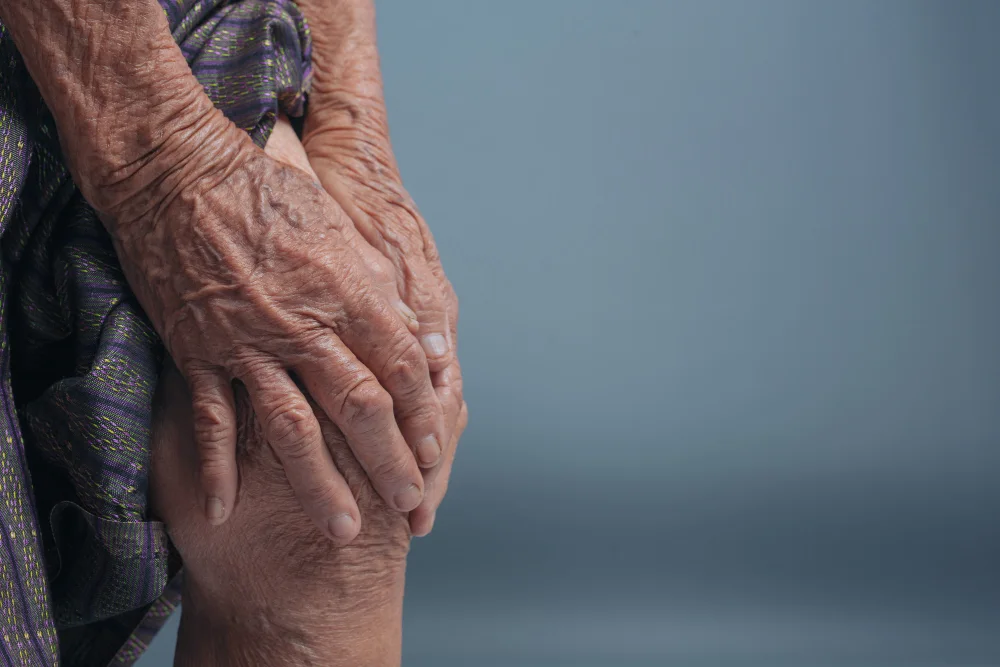
“Your cartilage is completely gone. You’re bone on bone. You need a knee replacement.” For many patients at Marin Joint Health, those are the exact words they heard before they started looking for another option. If that is where you are right now – in Novato, in Marin County, or anywhere in between – the honest answer is that surgery is not always your only path forward. Dr. Sarah Scharf has been treating bone-on-bone knee pain non-surgically for years, and the results are often significantly better than patients expect when they first walk through the door.
What Does Bone-on-Bone Actually Mean?
Bone-on-bone is not a formal medical diagnosis – it is a description of what shows up on an X-ray when the cartilage in the knee joint has worn away to the point where the joint space appears collapsed. In a healthy knee, a visible gap between the femur and tibia on an X-ray indicates cartilage cushioning the joint. When that gap disappears, the cartilage is gone – and the raw bone surfaces are in direct contact or close to it.
What the imaging does not show is how much pain the patient is actually in, how well they are functioning, or what other structures around the knee are contributing to their symptoms. Two patients with identical X-rays can have very different levels of pain and disability. That disconnect between imaging and symptoms is one of the most important things to understand about bone-on-bone knee pain.
Why Surgery Is Not the Only Answer
Total knee replacement is a major operation. It involves removing the damaged joint surfaces and replacing them with metal and plastic components. Recovery takes months. Complications – while not common – can include infection, blood clots, stiffness, and implant problems. And a significant percentage of patients who have knee replacement surgery continue to have meaningful pain afterward.
Research consistently shows that many patients with bone-on-bone osteoarthritis who pursue non-surgical treatment achieve pain levels and functional outcomes comparable to surgical patients – without the risks, the recovery time, or the permanence of having an artificial joint.
Surgery also does not address the biomechanical, neuromuscular, and systemic factors that contributed to the cartilage loss in the first place. If those factors are not corrected, the stress that wore away the original cartilage continues – now applied to an artificial joint that has its own lifespan and limitations.
What Non-Surgical Treatment Can Actually Do for a Bone-on-Bone Knee
This is where patients are often genuinely surprised. The assumption is that if there is no cartilage, there is nothing to treat. But that assumption misses several important things about what is actually driving the pain.
The Cartilage Is Gone, But the Inflammation Is Not
A significant portion of bone-on-bone knee pain comes from the chronic inflammation in the joint capsule, synovial lining, and surrounding soft tissue – not just the bone-on-bone contact itself. Reducing that inflammation through therapies like Class 4 laser therapy and focused shockwave therapy can meaningfully reduce pain even when cartilage restoration is not possible.
Joint Space Can Be Increased
Knee-On-Trac decompression therapy gently separates the joint surfaces, reduces compressive load, and draws synovial fluid back into the joint space. Even in significantly degenerated joints, this mechanical decompression reduces pain, improves lubrication, and takes pressure off the bone surfaces. Many bone-on-bone patients feel meaningful relief from decompression even when their imaging looks severe.
Abnormal Load Is a Major Pain Driver
When the kinetic chain is misaligned – tight hips, poor foot mechanics, spinal imbalance – the knee takes abnormal forces with every step. In a healthy knee with full cartilage, those forces are absorbed and distributed. In a bone-on-bone knee, they are concentrated directly on the damaged surfaces. Chiropractic care and custom orthotics correct those alignment issues, which can dramatically reduce the mechanical pain load the knee is carrying even without any change in the underlying structural damage.
Muscle Support Matters Enormously
Strong, well-functioning muscles around the knee – particularly the quads, hamstrings, and hip stabilizers – act as a secondary shock absorption system. When those muscles are working properly, they absorb a significant portion of joint load before it ever reaches the bone surfaces. Rebuilding that muscular support through the neuromuscular reset of Trigenics Neuro-Kinetic Therapy and a structured strengthening program is one of the most effective pain management strategies available for bone-on-bone knees.
The 12-Week Protocol for Bone-on-Bone Knee Pain
At Marin Joint Health, bone-on-bone patients are among the most common presentations Dr. Scharf sees. The 12-week knee pain relief protocol was built with this patient population in mind – people who have significant structural damage, who have often been told surgery is their only option, and who want a serious, evidence-based alternative before making that decision.
The protocol combines nine therapies that address every layer of the pain simultaneously: joint decompression, cellular repair, inflammation reduction, biomechanical correction, neuromuscular reset, home LED therapy, custom orthotics, anti-inflammatory nutrition, and a progressive strengthening program. No single one of these therapies is the answer. Together, they address the full picture of what is driving the pain.
Most patients attend two to three sessions per week for 12 weeks. Between visits, they use a professional-grade LED therapy device at home daily to support continuous healing. The goal by the end of the program is meaningful, lasting reduction in pain and a genuine improvement in function – the ability to walk further, sleep better, manage stairs, and do the things that matter to them.
Who Is a Good Candidate for Non-Surgical Treatment?
Not every bone-on-bone patient is a candidate for conservative care, and Dr. Scharf is direct about that. If the joint is severely deformed, if there is significant instability from ligament failure, or if pain is completely debilitating with any weight-bearing at all, surgery may genuinely be the more appropriate path.
But for the majority of patients with bone-on-bone findings who still have reasonable function – who can walk, who have pain that varies with activity level, who have not yet tried a comprehensive non-surgical program – there is a real case for exhausting conservative options first. A knee replacement is permanent. It is worth being certain you need one before you commit to it.
Dr. Scharf will give you an honest assessment at your evaluation. If she believes the protocol can help you meaningfully, she will tell you why. If she believes you are beyond what conservative care can realistically offer, she will tell you that too. There is no pressure, no overselling – just a clear picture of what your options are and what the realistic expectations look like.
What Patients Say
The patients who come to Marin Joint Health with bone-on-bone knee pain are often skeptical. They have heard the surgery recommendation, they have tried cortisone shots, they have done physical therapy. They are not sure anything else is going to work. That skepticism is completely understandable – and it is also why the patient testimonials on this site matter. Real patients, real conditions, real outcomes.
If you have been told you need a knee replacement and want to understand what non-surgical treatment could realistically offer you in Novato or anywhere in Marin County, the first step is a thorough evaluation. Schedule a consultation with Dr. Sarah Scharf at Marin Joint Health or call (415) 818-0243. Flexible payment plans are available for the 12-week program.