
Home Services Spinal Decompression
Spinal Decompression Therapy
Hips unload. You heal.
Your knees do not work alone. When the spine and lower back are out of balance, your joints pay the price. Spinal decompression relieves that strain, and we show you exactly where it starts.
Conservative care for knee and joint pain.
At a glance
Day one
We show you how your back is loading your hips and knees.
No downtime
A calm, computer-controlled stretch.
Non-invasive
A non-surgical approach to spinal decompression.
At a glance
Spinal decompression, explained
01
What it is
Spinal decompression therapy uses gentle, controlled traction to take pressure off the spine and the nerves that run through it. It eases back pain and supports the whole kinetic chain that your knees and hips depend on. It is part of the bigger-picture care that sets this practice apart.
02
How it works
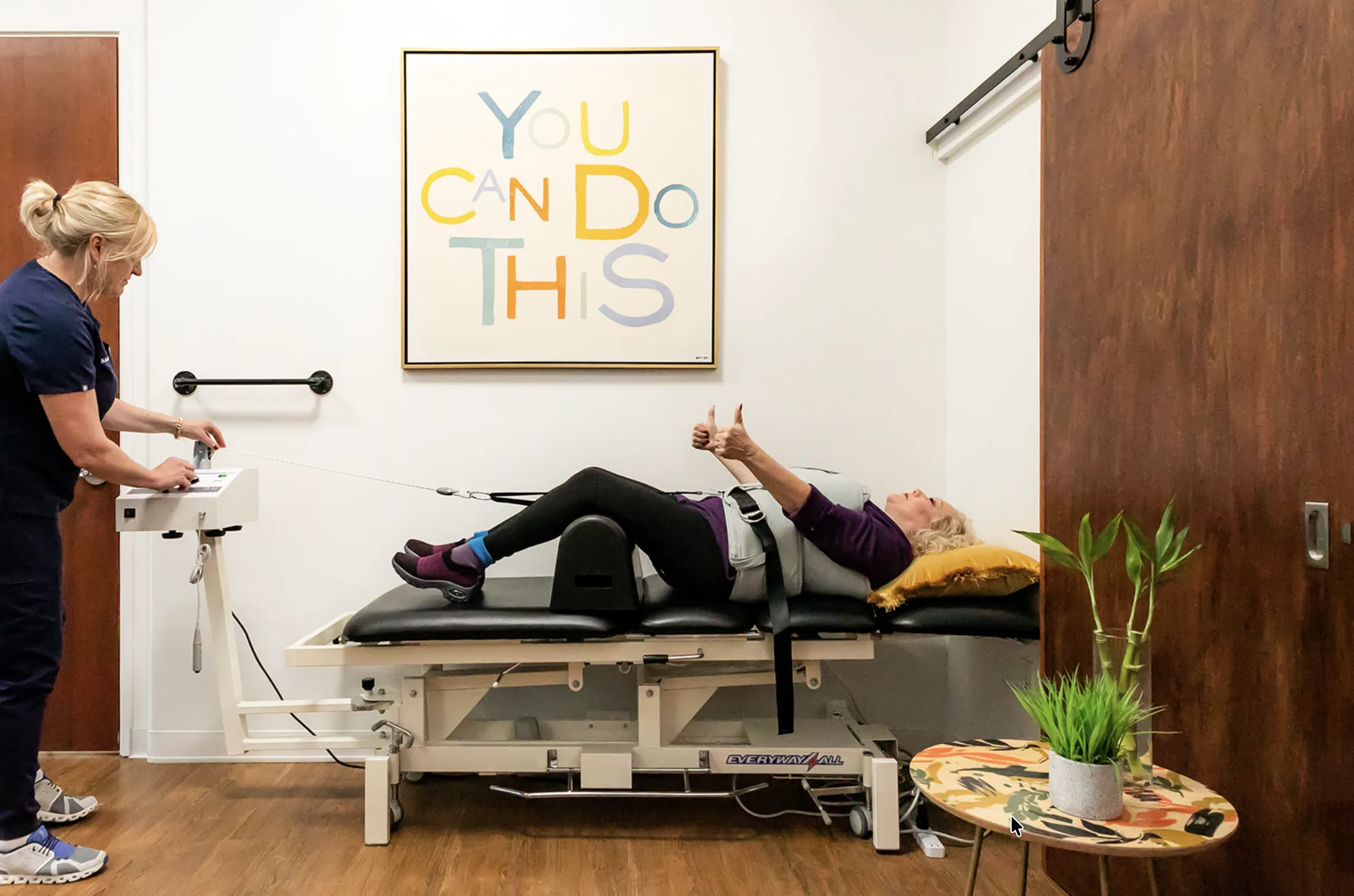
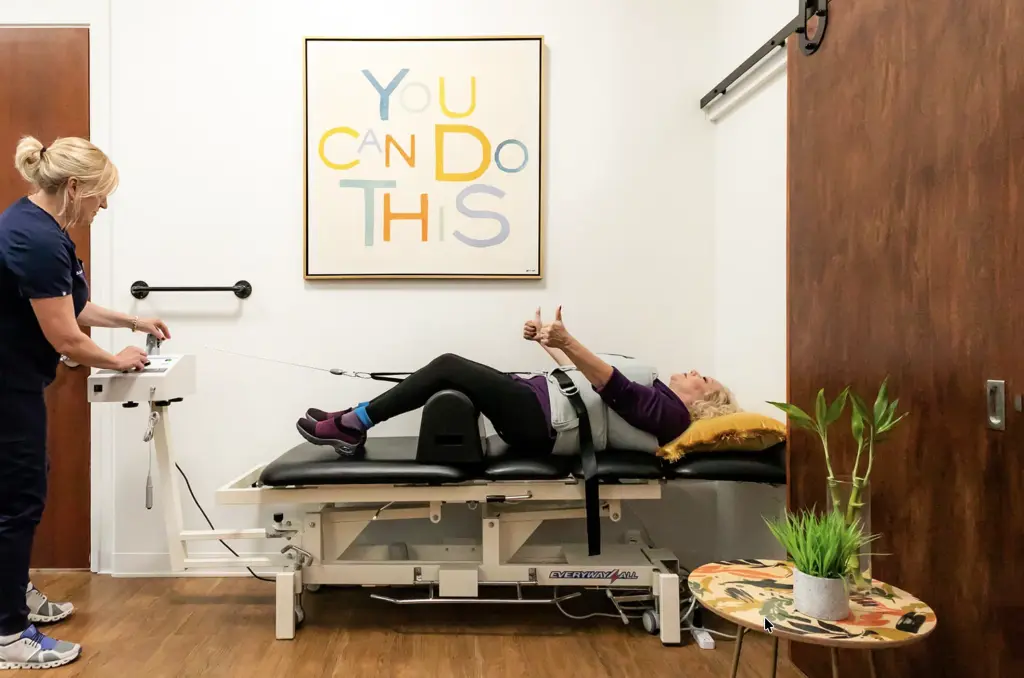
You lie comfortably while the table applies a slow, targeted stretch to the spine. That gentle pull creates space between the vertebrae, relieves pressure on discs and nerves and encourages healthier movement. The session is relaxing and completely non-invasive.
03
How it helps
Pain and dysfunction in the lower back can change how you walk and stand, which then overloads the knees. Easing that pressure helps the whole chain move better. Our doctors include spinal work when the source of joint pain reaches beyond the joint itself.
Understand why you hurt
Your Discs Have No Blood Supply — and That Changes Everything
The discs between your vertebrae are living tissue, yet by early adulthood they have almost no direct blood supply. They cannot be fed the way muscle is fed. Instead they work like a sponge: when pressure on the disc drops, fluid and nutrients seep in from the surrounding tissue, and when pressure rises, waste is pressed back out. Movement and unloading are, quite literally, how a disc eats.
Modern life interferes with that exchange. Hours of sitting, standing and gravity keep the disc under near-constant compression, so the inflow phase rarely gets its turn. Over years, an under-nourished disc loses hydration and height, its outer wall weakens and the openings where nerve roots exit the spine narrow. That is when back pain starts to travel: into the hip, down the leg or into the way you walk.
A compressed disc is not just a sore spot. Spinal decompression uses a computer-controlled stretch as one part of conservative chiropractic care.
Day one: we explain
On day one we show you what’s happening in your spine, and how it connects to the hip or knee that hurts.
How it works
What Happens on the Decompression Table
This is not old-fashioned static traction. A computer-controlled table applies a gentle, cyclical pull calibrated to your body, your condition and your comfort.
01
Cyclical traction, not a constant stretch
The table alternates gentle pull and partial release in slow waves. The rhythm keeps your muscles relaxed instead of guarding, so the stretch actually reaches the spine.
02
Lower pressure inside the disc
As the vertebrae ease apart, pressure inside the disc drops. That gentle vacuum draws fluid and nutrients inward and may help bulging disc material settle back toward its center.
03
Room for irritated nerves
Increasing the space between vertebrae takes mechanical pressure off the nerve roots, often the source of pain that radiates into the buttock or leg.
Who it’s for
Who Tends to Benefit, and Where It’s Aimed
Decompression is targeted to the lumbar spine and tailored to what your examination shows.
Disc-related low back pain
Bulging or degenerating lumbar discs that ache with prolonged sitting or flare with certain movements are the classic candidates.
Nerve-root symptoms
Sciatica-type pain, tingling or heaviness that travels into the leg often traces to a narrowed opening irritating the nerve as it leaves the spine.
Back trouble that overloads the rest of the chain
A guarded, stiff lower back changes how you stand and walk, quietly overloading the hips and knees below it. Unloading the spine is sometimes the first step in solving a knee problem.
Honest about limits
Some spines need a surgeon. We’ll tell you.
If your exam shows signs that decompression can’t safely help, we say so on day one and refer you to the right specialist, before you commit to anything.
That honesty is why surgeons and MDs refer their pre-surgical patients to us.
Complete approach. Complete care.
How It Fits the Bigger Plan
Decompression creates the physical conditions for recovery. The therapies around it make the most of that window.
01
The unloading phase of care
Sessions are calm and completely non-invasive. You lie comfortably while the table works, and most patients find the rhythm genuinely relaxing.
02
Paired with tissue-level support
Class IV laser can be applied along the spine to calm irritated tissue and support cellular repair while the disc environment improves.
03
Held in place by strength
Core and hip strengthening from your home program helps maintain the improved disc environment between visits, and long after your care plan ends.
You learn to manage it yourself: you’ll know how sitting, lifting and daily movement load your discs, and what to do about it.
Feel better. Live better.
Give Your Discs Room to Recover
If your back has been compressed, guarded and aching for months, the missing ingredient may simply be space. An exam will show whether your spine is a good candidate, and we’ll explain why.
Patient reviews
Finally explained. In their own words.
Read what patients have shared about their care.
-
I was very skeptical, at first, about Marin Joint Health due to my unsuccessful search for treatment for my prolonged severe amount of pain. Having just completed two months of treatment, I am a true believer! Dr. Scharf for her comprehensive diagnosis and Dr. Jay for his incredible hands-on physical therapy, as well as Gabby for being an excellent technician, have made my treatments successful…
-
I had an ongoing knee issue from an old ACL injury, and the team at Marin Joint Health provided wonderful care and effective treatment. My knee has improved significantly, and I now have much less pain. I'm so grateful for their expertise and highly recommend them to anyone dealing with similar issues.
-
I highly recommend Marin Joint Health. I have had some really great results working with Dr. Scharf and her incredible team. In my experience, all the staff are confident, knowledgeable, easy to deal with, and very cheerful. Thank you.
-
Having my knee treated at Marin Joint Health is one of the best decisions I've ever made. My knee pain is gone and I'm walking again easily and enjoying it. Thank you Dr. Sara Scharf, you are amazing.
-
Marin Joint Health has helped me find relief from the discomfort of neuropathy. Dr Sharf and her excellent staff care about their patients well being. Treatment plan includes full body adjustment to ensure sustained spinal health.
-
I love the quality of care I’m receiving! And Dr. Scharf and her staff are wonderful! I’m so glad I signed up for this program to treat my knees, osteoarthritis and meniscus tears!
-
This medical team is 100% dedicated to healing patients. Their approach is holistic and delivered with utmost care and “sweet” loving words. I hope to dance flamenco soon in their honor!
-
Love the fact that everyone here are with a positive attitude and always smiling. The attention that they give you its amazing. I definitely recommend everyone .
-
Awesome place to come in and receive chiropractic care. My first neck adjustment made me feel so much better. Dr Scarf DC is a pro!!!
-
I have found the staff knowledgeable, caring, and more than willing to explain and answer questions. I am excited to be treated with researched alternative therapies instead of surgery.
-
Dr. Scharf is the best! Every experience is unique and amazing. She is always in tune with me, and I feel blessed to be under her care.
-
My rate for them is 5 stars also. I recommended so much because in the first 3 visits I have no pain in my knees, The staff is very helpful and very professional.
Individual results vary.
FAQ
Frequently Asked Questions
Still have questions? Call us and we’ll explain exactly how we can help.
It helps people with back pain, nerve irritation, or knee and hip issues that trace back to spinal alignment and movement. Your day-one exam shows whether your spine is a good candidate.
You rest on a comfortable table while it does the work. Most people find the gentle, cyclical stretch soothing, and we explain what it is doing for your discs.
Sessions are short and relaxing, and your plan sets how many you need after a full exam. You leave day one knowing the plan and the reason for it.
It is most effective as part of a coordinated approach that also addresses how you move day to day, including core and hip strength from your home program.
There is no downtime. Relief often builds steadily across a series of sessions, and we track and explain your progress as you go.
No. The goal is a spine you understand and can protect yourself. Tune-up visits are there if you want them, but they are optional, never a requirement.

Feel better. Live better.
Finally understand why you hurt—and get your life back
We explain what’s wrong, build a complete conservative plan and teach you how to stay ahead of it for life.