Treatment
Joint Mobility and Restorative Care
Stiff, aching joints can make everyday movement feel like work. Restorative care helps your joints move freely again.
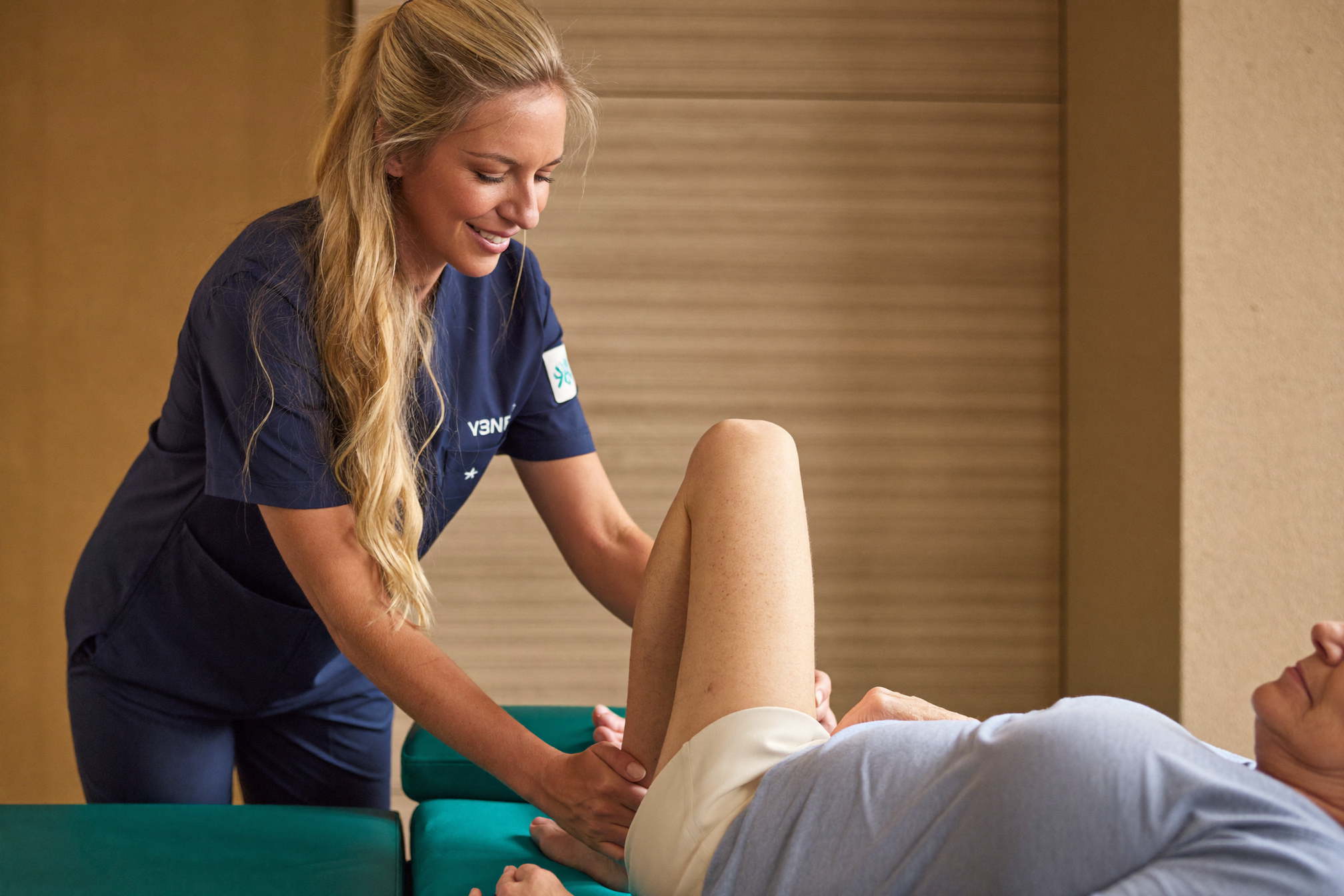
Joint mobility and restorative care focuses on getting stiff, restricted joints moving the way they should. It combines hands-on techniques with targeted therapies to restore range of motion and support healthier tissue. It applies the same restorative approach we use for knees to joints throughout the body.
We assess where motion is limited and why, then use a mix of adjustments, soft-tissue work, and therapy to free up the joint. As mobility returns, we add movement and strengthening so the gains hold. Each step is matched to what your body is ready for.
Joints that do not move well tend to get worse and drag down the joints around them. Restoring mobility eases pain, improves how you move, and helps prevent new problems. Dr. Sarah Scharf, DC, uses it to keep patients active and comfortable in daily life.
Stiff joints aren't rusty — they're adapted
A stiff joint feels mechanical, like a hinge that needs oil. What's actually happening is biological: the tissues around a joint continuously remodel themselves to match the range of motion you actually use. Ask less of a joint — because it hurts, because of a desk, because an old injury made you cautious — and the joint capsule and surrounding fascia gradually shorten and thicken to fit that smaller life. Your body isn't malfunctioning; it's economizing.
Motion also does a job no medication can: it circulates synovial fluid, the joint's built-in lubricant and nutrient supply. Cartilage has no blood vessels of its own — it feeds by soaking up synovial fluid as the joint moves and compresses, like a sponge being squeezed and released. Less motion means less circulation, which means a less nourished joint that stiffens further.
The encouraging part is that adaptation runs both directions. The same use-it-or-lose-it biology that took your range away can rebuild it, if the new demand arrives gradually and consistently. That is the whole premise of restorative care.
How a joint quietly loses its range
Stiffness usually develops in layers over months to years — each one addressable when you work in the right order.
The capsule tightens
The fibrous envelope around the joint lays down extra collagen cross-links in the ranges you no longer visit, physically lowering the ceiling on your motion.
Fascia layers stop gliding
The connective-tissue sheets around your muscles are meant to slide over one another. Underused, they become tacky and adherent, so movement feels thick and restricted even when the joint surfaces themselves are healthy.
Synovial fluid stagnates
With less motion, less fluid circulates through the joint, so cartilage receives less nourishment and morning stiffness lingers longer before you loosen up.
Neighboring joints pay the tax
When one joint stops contributing motion, the joints above and below move extra to compensate — which is how one stiff hip becomes a sore knee or an aching low back.
How we restore motion — gradually, on purpose
Forcing range into a guarded joint backfires. We layer techniques so each gain is one your body accepts and keeps.
Find the true limiter
Your exam sorts out whether the restriction lives in the capsule, the soft tissue, or protective muscle guarding, because each responds to different tools.
Free the tissue
Gentle chiropractic work restores joint play, while Graston and cupping restore glide between fascial layers — releasing the stuck hardware before asking it to move more.
Feed the joint with motion
Specific daily movements keep synovial fluid circulating between visits, turning every day into a small dose of joint nutrition.
Load the new range
Strength work inside your recovered range signals the capsule and fascia to keep it. Range you can control under load is range you keep.
Beyond the knee
This care extends our restorative approach to the whole body — hips, shoulders, spine, and ankles — using the same logic as our knee programs.
Same biology, every joint
Capsule adaptation, fascial glide, and synovial circulation govern shoulders and hips just as they do knees, so the restorative sequence transfers directly.
Built for how you want to move
Trails, golf swings, and pickleball all demand rotation and range that desk-bound days quietly erode. Restoring mobility is often what makes returning to them comfortable again.
A starting point or a companion
Some patients begin here for a single stiff joint; others add it alongside a knee program so the rest of the body keeps up with the joint being rebuilt.

Get your range of motion back — and keep it
If a joint has been shrinking your movement one small compromise at a time, an exam can show exactly where the restriction lives and how to unwind it safely.
Book a joint mobility examFAQFrequently Asked Questions
It is for patients with stiff, restricted, or aching joints who want to move more comfortably and freely.
Care is gentle and hands-on, with most people noticing easier movement as treatment progresses.
Your plan depends on how restricted the joint is, which we determine during your exam.
Keeping up with the movement work between visits protects the mobility you regain.
There is no downtime. Range of motion often improves early, with steady gains over time.
 Marin Joint Health
Lasting relief from knee and joint pain without surgery
If knee or joint pain is holding you back, Dr. Sarah Scharf, DC, treats the root cause, not just the symptoms, without surgery or drugs.