Treatment
Spinal Decompression Therapy
Your knees do not work alone. When the spine and lower back are out of balance, your joints pay the price, and spinal decompression helps relieve that strain.
Spinal decompression therapy uses gentle, controlled traction to take pressure off the spine and the nerves that run through it. It eases back pain and supports the whole kinetic chain that your knees and hips depend on. It is part of the bigger-picture care that sets this practice apart.
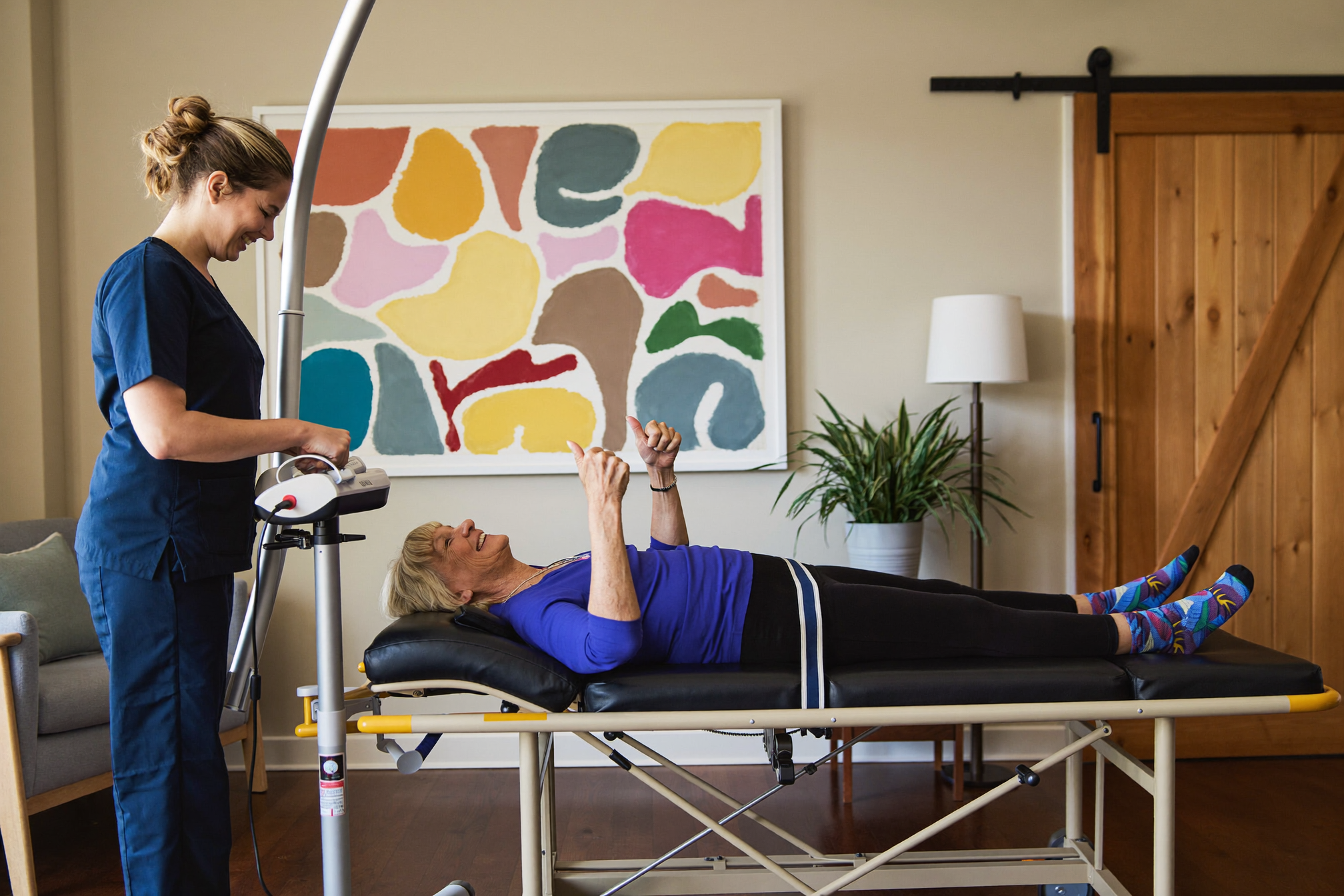
You lie comfortably while the table applies a slow, targeted stretch to the spine. That gentle pull creates space between the vertebrae, relieves pressure on discs and nerves, and encourages healthier movement. The session is relaxing and completely non-invasive.
Pain and dysfunction in the lower back can change how you walk and stand, which then overloads the knees. Easing that pressure helps the whole chain move better. Dr. Sarah Scharf includes spinal work when the source of joint pain reaches beyond the joint itself.
Your discs have no blood supply — and that changes everything
The discs between your vertebrae are living tissue, yet by early adulthood they have almost no direct blood supply. They cannot be fed the way muscle is fed. Instead they rely on a process called imbibition: when pressure on the disc drops, fluid and nutrients seep in from the surrounding tissue, and when pressure rises, waste is pressed back out. Movement and unloading are, quite literally, how a disc eats.
Modern life interferes with that exchange. Hours of sitting, standing, and gravity keep the disc under near-constant compression, so the inflow phase rarely gets its turn. Over years, an under-nourished disc loses hydration and height, its outer wall weakens, and the openings where nerve roots exit the spine narrow. That is when back pain starts to travel — into the hip, down the leg, or into the way you walk.
A compressed disc is not just a sore spot — it is tissue slowly being starved of the fluid exchange it needs to maintain itself. Spinal decompression therapy is designed to restore that exchange without surgery, injections, or medication.
What happens on the decompression table
This is not old-fashioned static traction. A computer-controlled table applies a gentle, cyclical pull calibrated to your body, your condition, and your comfort.
Cyclical traction, not a constant stretch
The table alternates gentle pull and partial release in slow waves. The rhythm matters — it keeps your muscles relaxed instead of guarding, so the stretch actually reaches the spine rather than being absorbed by tense tissue.
Negative pressure inside the disc
As the vertebrae ease apart, pressure inside the disc drops below that of the surrounding tissue. That gentle vacuum draws fluid and nutrients inward and can encourage bulging disc material to retreat toward its center.
Room for irritated nerves
Increasing the space between vertebrae takes mechanical pressure off the nerve roots — often the source of pain that radiates into the buttock or leg.
Who tends to benefit, and where it's aimed
Decompression is targeted to the lumbar spine and tailored to what your examination shows.
Disc-related low back pain
Bulging or degenerating lumbar discs that ache with prolonged sitting or flare with certain movements are the classic candidates.
Nerve-root symptoms
Sciatica-type pain, tingling, or heaviness that travels into the leg often traces to a narrowed opening irritating the nerve as it leaves the spine.
Back trouble that overloads the rest of the chain
A guarded, stiff lower back changes how you stand and walk, quietly overloading the hips and knees below it. Unloading the spine is sometimes the first step in solving a knee problem.
How it fits the bigger plan
Decompression creates the physical conditions for recovery; the therapies around it make the most of that window.
The unloading phase of care
Sessions are calm and completely non-invasive — you lie comfortably while the table works, and most patients find the rhythm genuinely relaxing.
Paired with tissue-level support
Class IV laser can be applied along the spine to calm irritated tissue and support cellular repair while the disc environment improves.
Held in place by strength
Core and hip strengthening from your home program helps maintain the improved disc environment between visits — and long after your care plan ends.

Give your discs room to recover
If your back has been compressed, guarded, and aching for months, the missing ingredient may simply be space. An exam will show whether your spine is a good candidate.
Find out if decompression fits your spineFAQFrequently Asked Questions
It helps patients with back pain, nerve irritation, or knee and hip issues that trace back to spinal alignment and movement.
You rest on a comfortable table while it does the work. Most people find the gentle stretch soothing.
Sessions are short and relaxing, and your plan sets how many you need after a full exam.
It is most effective as part of a coordinated approach that also addresses how you move day to day.
There is no downtime. Relief often builds steadily across a series of sessions.
 Marin Joint Health
Lasting relief from knee and joint pain without surgery
If knee or joint pain is holding you back, our doctors treat the root cause, not just the symptoms, without surgery or drugs.